
NEET Retention Strategy Planner
Stop passive reading. Use this tool to identify the best memory technique for your specific study material. Select a subject and your primary challenge to get a customized strategy recommendation based on proven cognitive science principles.
Recommended Technique
High Confidence MatchAction Plan:
Suggested Review Schedule:
You have roughly 180 days left before the exam. The syllabus hasn't shrunk. If you are still reading chapters like a novel, hoping the information sticks by osmosis, you are wasting time. Most students fail not because they don't understand concepts, but because they forget them under pressure. NEET is an all-India undergraduate medical entrance examination that tests knowledge across Physics, Chemistry, and Biology with a heavy emphasis on factual retention and application. The fastest way to memorize isn't about speed-reading; it's about hacking your brain's natural forgetting curve.
Stop Passive Reading, Start Active Recall
Here is a hard truth: highlighting your NCERT textbook feels productive, but it does almost nothing for long-term memory. When you read a paragraph, you recognize the words. Recognition is easy. Recall is hard. To memorize fast, you need to struggle slightly. This is called Active Recall is a learning technique where you actively retrieve information from memory rather than passively reviewing notes or textbooks. It forces your brain to strengthen neural pathways every time you pull a fact out of thin air.
How do you actually do this? Close the book. Ask yourself what you just read. If you can't explain the Krebs cycle steps without looking, you haven't learned it. You've only recognized it. Use blank-sheet method: take a whiteboard or plain paper, write the topic name (e.g., "Human Heart Structure"), and scribble everything you remember. Then open the book and check gaps. Those gaps are your real study targets. This method cuts study time because you stop re-reading what you already know.
Leverage Spaced Repetition Systems
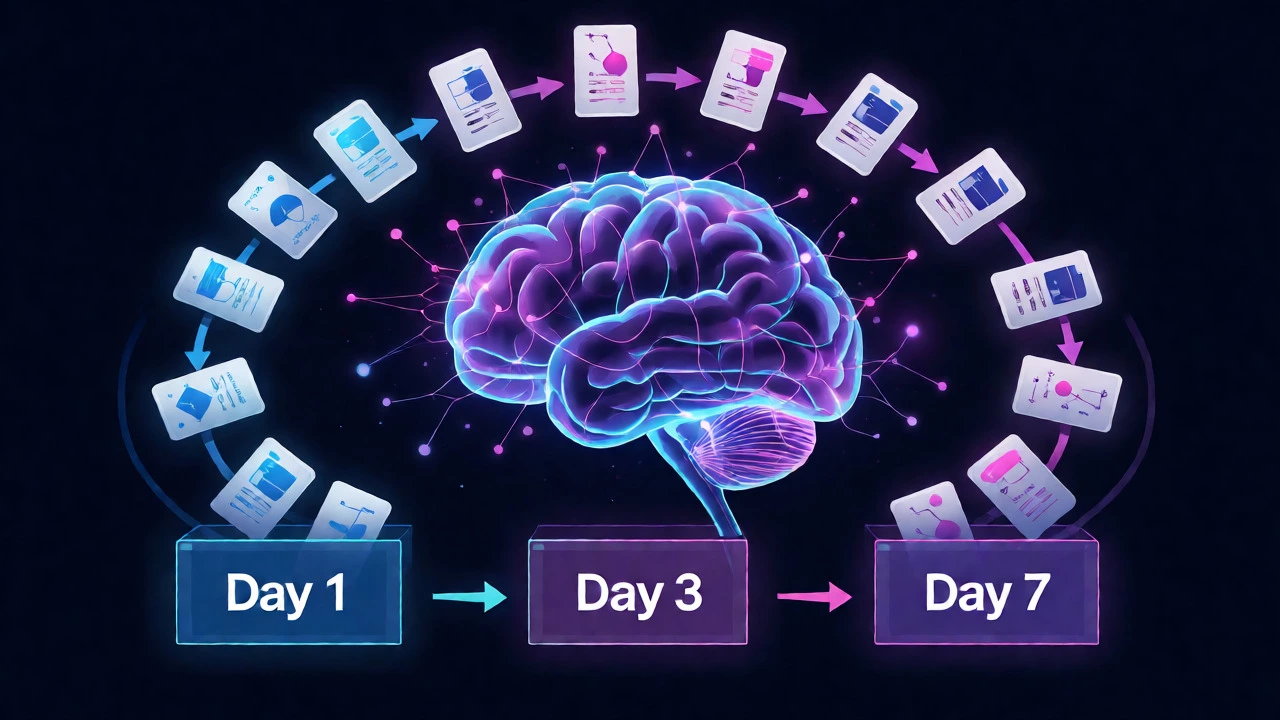
Your brain deletes unused data aggressively. Psychologist Hermann Ebbinghaus mapped this in the late 19th century as the Forgetting Curve. Without review, you lose about 70% of new information within 24 hours. Spaced Repetition is a learning technique that incorporates increasing intervals of time between subsequent reviews of previously learned material. It works because it interrupts the forgetting process right when you're about to forget.
You don't need complex algorithms if you stick to a simple schedule. Review new facts after 1 day, then 3 days, then 7 days, then 21 days. Apps like Anki automate this, but many students find digital flashcards distracting. A physical box system works better for tactile learners. Label boxes: Box 1 (Review Daily), Box 2 (Every 3 Days), Box 3 (Weekly). Move cards to higher boxes only when you get them right twice in a row. For NEET Biology, this is non-negotiable. There are too many exceptions in taxonomy and plant physiology to rely on short-term memory.
The Power of Mnemonics and Chunking
Raw data is hard to hold. Stories and weird images are easy. Your brain evolved to remember faces, places, and dangers, not abstract chemical formulas. Mnemonics are learning aids that help people remember information through associations, such as acronyms, rhymes, or visual imagery. They turn dry facts into sticky hooks.
Take the order of taxonomic ranks: Kingdom, Phylum, Class, Order, Family, Genus, Species. The classic mnemonic "King Philip Came Over For Good Soup" works, but make it personal. Create a story where King Philip trips over a good soup bowl. The weirder the image, the better it sticks. For Chemistry, chunking is vital. Don't try to memorize the entire periodic table at once. Break it into groups. Learn Group 1 elements as one block, halogens as another. Link properties to the group identity. Sodium is soft, reactive, floats on water-picture sodium ice skating. These vivid mental anchors reduce cognitive load significantly.
| Technique | Best For | Time Investment | Retention Strength |
|---|---|---|---|
| Active Recall | Biology Concepts, Physics Formulas | High initially, low later | Very High |
| Spaced Repetition | Factual Data, Dates, Exceptions | Consistent daily maintenance | Long-Term |
| Mnemonics | Taxonomy, Organic Reagents | Low (setup only) | Medium-High |
| Past Papers | Application, Pattern Recognition | Medium (during practice) | Contextual |
Interleaving Beats Blocking
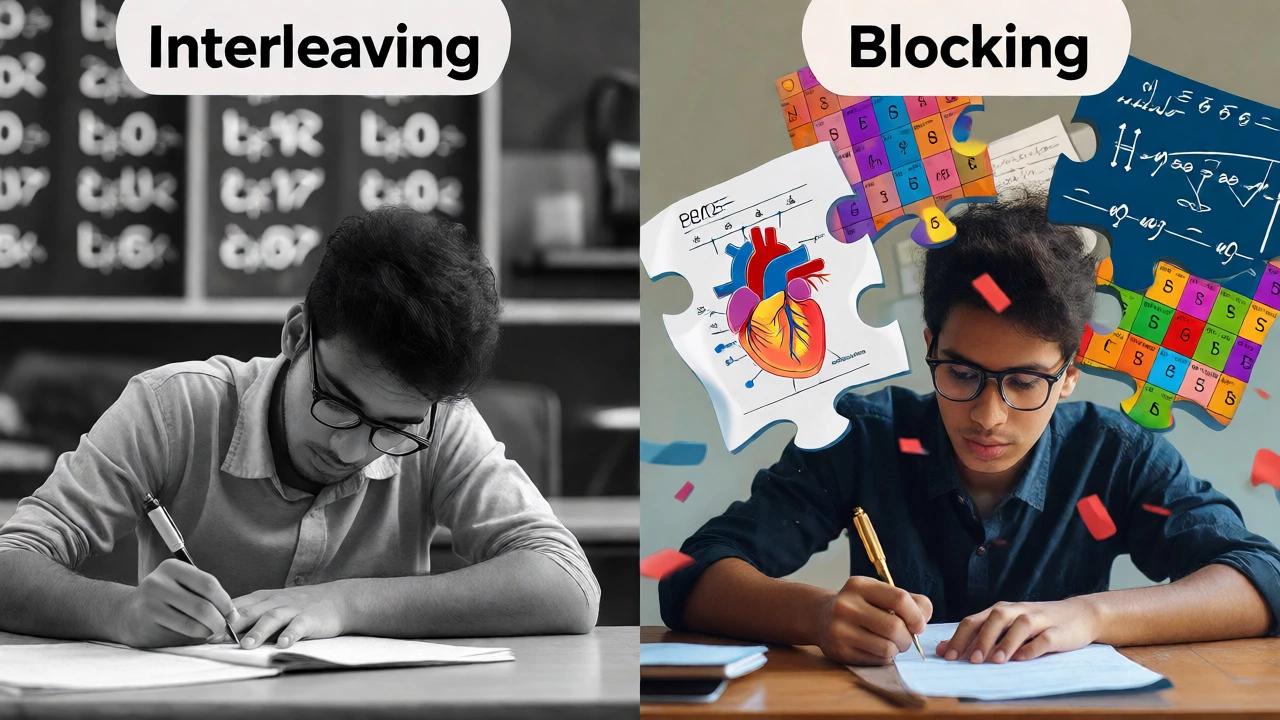
Most students study Physics for three hours, then Chemistry for three hours. This is blocking. It feels efficient, but it creates an illusion of competence. You get used to solving similar problems back-to-back. In the actual exam, questions come randomly mixed. Interleaving is a practice method where different topics or types of problems are mixed together rather than studied in blocks. It forces your brain to distinguish between problem types and select the right strategy.
Try this: Do five physics mechanics problems, then two chemistry mole concept questions, then three biology genetics problems. Switch subjects every 20 minutes. At first, accuracy drops. That's normal. The struggle is building flexible thinking. By exam day, you won't panic when a thermodynamics question follows a botany one. You'll simply switch gears. This mirrors the actual test environment and reduces anxiety-induced blankouts.
Teach It to Simplify It
If you can't explain it simply, you don't understand it well enough to remember it. This is the Feynman Technique. Pretend you're teaching a younger sibling or a friend who knows nothing about medicine. Speak out loud. Use analogies. "The mitochondria is the powerhouse of the cell" is boring. "The mitochondria is like a power plant that burns glucose fuel to create electricity for the city" is memorable.
When you teach, you expose your own confusion points. Maybe you glossed over how blood pressure regulation works. Teaching reveals that gap immediately. Go back, fix it, and try again. This loop compresses learning time because you aren't studying what you already know. You're targeting weaknesses. For NEET, where negative marking punishes guesswork, deep understanding prevents silly errors caused by half-remembered facts.
Optimize Your Environment and Sleep
Memorization happens during sleep. Specifically, during REM cycles, your brain consolidates short-term memories into long-term storage. Pulling all-nighters destroys this process. You might feel tired but wired, yet your recall will be sluggish. Aim for 7-8 hours of quality sleep. No exceptions.
Also, manage your phone. Every notification breaks focus. It takes up to 23 minutes to fully regain concentration after an interruption. Keep your phone in another room while doing active recall sessions. Use a timer. Work in 50-minute sprints with 10-minute breaks. During breaks, move around. Walk, stretch, drink water. Don't scroll social media. Let your mind rest, not reset to dopamine overload.
Practice with Negative Marking Pressure
Knowledge alone doesn't win NEET. Execution does. Practice full-length mock tests weekly. Analyze every mistake. Was it a lack of knowledge? A misread question? Or a memory lapse? Track these categories. If most errors are memory lapses, increase your spaced repetition volume. If they're conceptual misunderstandings, go back to NCERT theory.
Simulate exam conditions strictly. Sit at a desk, use an OMR sheet, set a timer. No pausing. This builds stamina and trains your brain to retrieve information under stress. The more you practice retrieval under pressure, the easier it becomes on the actual day.
Is NCERT enough for NEET Biology memorization?
Yes, NCERT is the primary source. However, "enough" means knowing every line, diagram caption, and summary point. Students often miss small details in appendices or scientific names. Use active recall specifically on NCERT text, not just supplementary books.
How many hours per day should I spend on revision?
Dedicate at least 20-30% of your total study time to revision using spaced repetition. As exams approach, this ratio should increase to 50%. New learning slows down; consolidation speeds up scores.
Do mnemonics work for Physics formulas?
Less so than for Biology or Chemistry. Physics requires derivation logic. Instead of rote memorizing formulas, understand their units and limiting cases. Mnemonics help for specific constants or sign conventions, but conceptual understanding drives formula selection.
What is the best app for NEET revision?
Anki is powerful for custom flashcards. However, many students prefer physical flashcards or handwritten notes because writing reinforces memory. Choose the tool you will actually use consistently, not the one that looks fancy.
Can I memorize organic chemistry reactions quickly?
Group reactions by mechanism, not just name. For example, all electrophilic aromatic substitutions follow similar patterns. Understanding the electron flow makes memorizing individual reagents easier. Use reaction maps connecting related compounds.