CSS Tool Selector: Language vs Framework
Describe Your Project Scenario
Select the option that best matches your current development needs.
I need to build a dashboard or admin panel quickly with standard components.
I have a unique design system and want full control without fighting default styles.
I want to master the fundamentals, minimize file size, and understand the browser.
Multiple developers working together; we need consistency and maintainability.
Select a scenario above to see the recommended approach.
You’ve probably heard the term "CSS framework" thrown around constantly. You might have even seen tutorials titled "How to use Bootstrap." It’s easy to assume that because these tools exist, Cascading Style Sheets (CSS) itself must be a framework or a library. But if you stop and think about how you actually write code, something feels off. You don’t import CSS. You don’t install it via npm. You just write it.
So, is CSS a library or a framework? The short answer is no. CSS is neither. It is a stylesheet language. Understanding this distinction isn't just semantic nitpicking; it changes how you approach your projects, how you debug issues, and how you choose the right tools for the job. Let's break down exactly what CSS is, why we often confuse it with frameworks, and what role libraries actually play in modern web design.
What Exactly Is CSS?
To understand why CSS isn't a framework, we first need to define what it is. Cascading Style Sheets, commonly known as CSS, is a style sheet language used for describing the presentation of a document written in HTML. It was created by Håkon Wium Lie and Bert Bos in 1996. Its primary job is to separate content from design. Before CSS, if you wanted to make text blue on every page of your website, you had to add an inline style attribute to every single paragraph tag. That was a nightmare.
CSS solves this by allowing you to define rules once. You say, "All paragraphs should be blue," and the browser applies that rule everywhere. It handles layout, colors, fonts, spacing, animations, and responsive behavior. It is a specification maintained by the World Wide Web Consortium (W3C). Because it is a standard language interpreted directly by the browser engine, it doesn't have the structure of a software package like a library or framework does.
Defining the Difference: Language vs. Library vs. Framework
The confusion usually stems from not clearly defining what libraries and frameworks are. In software engineering, these terms have specific meanings that CSS doesn't fit into.
- A Language: This is a system of communication between humans and machines. HTML is a markup language. JavaScript is a programming language. CSS is a styling language. They are the raw materials you build with. You learn syntax, rules, and logic.
- A Library: A library is a collection of pre-written code that you can call upon to perform specific tasks. You remain in control. You decide when and how to use the functions. For example, jQuery is a JavaScript library. You include it, and then you call its methods to manipulate the DOM. You drive the car; the library provides the spare tire and the jack.
- A Framework: A framework is a larger structure that provides a skeleton for your application. It dictates how your project should be organized. It uses "inversion of control," meaning the framework calls your code, not the other way around. React, Angular, and Vue are JavaScript frameworks. They enforce patterns, manage state, and handle rendering cycles. You fit your code into their mold.
CSS fits none of these definitions perfectly. It is the language. It is the foundation. Libraries and frameworks are built on top of CSS.
Why Do We Talk About "CSS Frameworks" Then?
If CSS is just a language, why do developers talk about "CSS Frameworks" all the time? This is where the terminology gets tricky. When people say "CSS Framework," they aren't referring to CSS itself. They are referring to a library or toolkit that generates CSS for you.
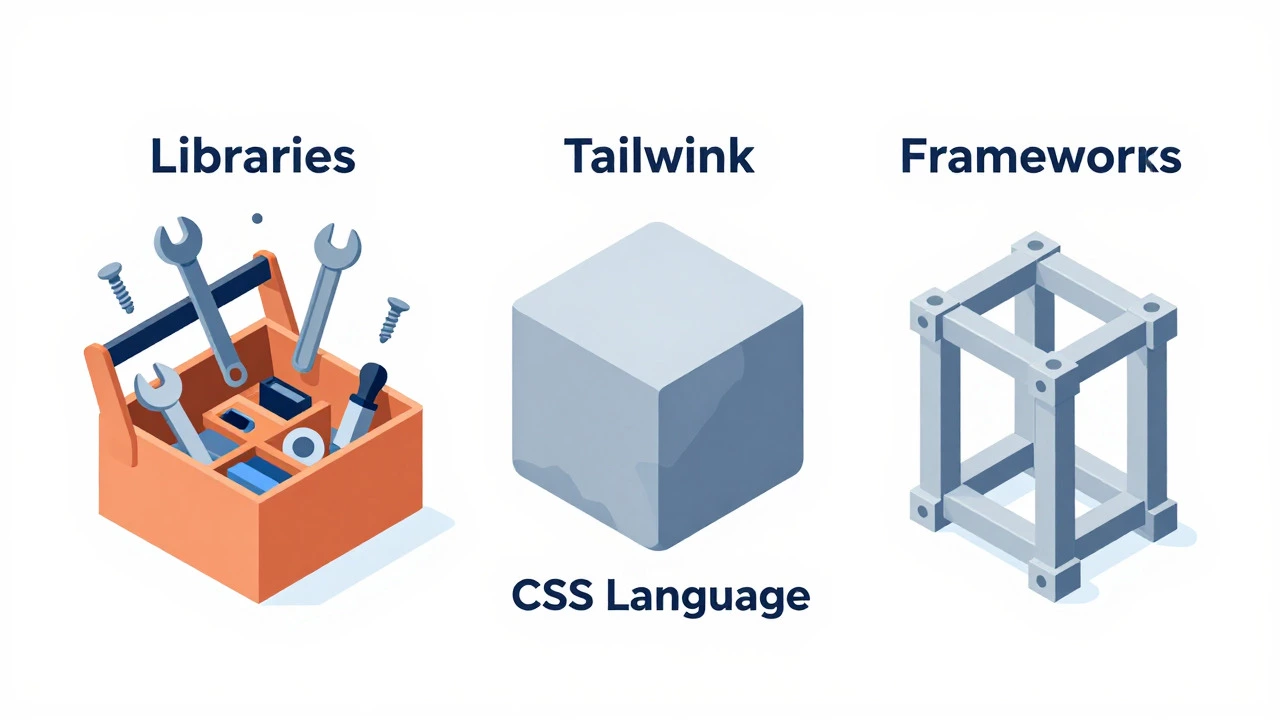
| Concept | Type | Control Level | Example |
|---|---|---|---|
| CSS | Language | Total Control (You write everything) | display: flex; |
| CSS Library | Collection of Utilities | High Control (You pick utilities) | Tailwind CSS |
| CSS Framework | Pre-built Components | Low Control (You follow conventions) | Bootstrap, Foundation |
Take Bootstrap, for example. Bootstrap is not CSS. Bootstrap is a toolkit that includes HTML, CSS, and JavaScript. It provides pre-styled buttons, navigation bars, and grids. When you use Bootstrap, you are using a framework that outputs CSS classes. You write <button class="btn btn-primary">, and Bootstrap’s underlying CSS makes it look like a button. The framework abstracts away the raw CSS properties like padding, border-radius, and color codes.
This abstraction is powerful for speed but can lead to bloat. If you only need one button style, importing the entire Bootstrap framework means you’re loading megabytes of unused CSS. This is why understanding the difference matters. You aren't learning "CSS" when you learn Bootstrap; you're learning how to use Bootstrap's API to generate CSS.
The Rise of Utility-First CSS Libraries
In recent years, the landscape has shifted again. Tools like Tailwind CSS have gained massive popularity. Tailwind is often called a framework, but technically, it is a utility-first CSS library. Instead of providing pre-made components like a navbar, it provides small, single-purpose classes like flex, pt-4, text-center.
Here is the key distinction:
- Traditional Frameworks (Bootstrap): Give you high-level components. You customize them by overriding their CSS.
- Utility Libraries (Tailwind): Give you low-level building blocks. You compose them to create your own unique designs without writing custom CSS files.
Even Tailwind relies on PostCSS, a tool that transforms CSS with JavaScript plugins. Tailwind scans your HTML, finds the utility classes you used, and generates a minimal CSS file. So, Tailwind is a build-tool-driven library that outputs CSS. It is still not CSS itself. It is a layer of automation sitting on top of the CSS language.
Common Misconceptions Debunked
Let’s address a few common myths that persist in the developer community.
Myth 1: "CSS is Turing Complete, so it's a Programming Language/Framework"
Some argue that because modern CSS has features like counters and variables, it is Turing complete and therefore a programming language. While CSS has become more powerful with logical operations and nesting, it lacks loops, conditionals (in the traditional sense), and data structures required for general-purpose programming. It remains a declarative language for styling, not an imperative framework for logic.
Myth 2: "If I Use SASS, I'm Using a CSS Framework"
SASS (Syntactically Awesome Style Sheets) is a CSS preprocessor. It adds features like variables, mixins, and nesting to CSS. However, SASS compiles down to plain CSS before the browser sees it. SASS is a tool to write CSS more efficiently, not a framework that dictates your app's structure. It enhances the language; it doesn't replace it.
Myth 3: "CSS-in-JS Libraries Are Just CSS"
Libraries like Styled Components or Emotion allow you to write CSS inside your JavaScript files. This is popular in React ecosystems. However, these are JavaScript libraries that dynamically inject CSS into the DOM at runtime. They are still libraries built around CSS, leveraging the browser's native CSS engine to render styles. The core mechanism is still the CSS language.

Why Does This Distinction Matter for Your Career?
Knowing that CSS is a language, not a framework, impacts how you hire, how you learn, and how you architect applications.
- Foundation First: If you jump straight into Bootstrap or Tailwind without understanding core CSS concepts like the box model, specificity, and the cascade, you will struggle to debug issues. When a style doesn't apply, you need to know why based on CSS rules, not just guess which framework class to override.
- Performance Optimization: Frameworks often include code you don't need. Understanding raw CSS allows you to write leaner stylesheets. You can achieve complex layouts with pure CSS Grid and Flexbox without importing heavy external dependencies.
- Flexibility: Frameworks impose opinions. If you want a design that breaks the grid system of Bootstrap, you fight the framework. If you know CSS, you can build any design without fighting against pre-defined constraints.
- Future-Proofing: Frameworks come and go. Bootstrap v3, v4, v5... each brings breaking changes. CSS standards evolve slowly and backward-compatibly. Mastering the language ensures your skills remain relevant regardless of which trendy library emerges next year.
Practical Advice: How to Approach CSS in 2026
So, how should you structure your workflow? Here is a recommended path for developers today.
1. Master the Core Language Start with vanilla CSS. Learn selectors, specificity, the cascade order, Flexbox, and Grid. Build simple layouts without any tools. This builds muscle memory for how browsers interpret styles.
2. Choose a Tool Based on Project Needs
- For rapid prototyping or admin dashboards: Use a component-based framework like Bootstrap or Bulma. You get consistent UI elements quickly.
- For custom, highly designed products: Use a utility-first library like Tailwind CSS. It offers flexibility while maintaining consistency through your design system.
- For large-scale enterprise apps: Consider CSS Modules or Scoped CSS within a JavaScript framework to prevent style collisions.
3. Don't Hide Behind Abstractions
Even if you use Tailwind, keep a CSS reference handy. Understand what md:flex actually translates to in raw CSS. This knowledge helps you troubleshoot when things go wrong.
Conclusion: Embrace the Language
CSS is not a library. It is not a framework. It is the fundamental language of web presentation. Libraries and frameworks are merely helpers that automate repetitive tasks or provide structural guidance. They are tools, not the material itself. By recognizing CSS for what it is-a powerful, evolving language-you gain the freedom to build anything you imagine, unbound by the limitations of third-party packages. Start with the basics, master the cascade, and let frameworks serve you, not dictate your creativity.
Is CSS considered a programming language?
No, CSS is not a programming language. It is a stylesheet language. Programming languages like JavaScript have logic, variables, loops, and conditional statements that execute actions. CSS is declarative; it describes how elements should look, but it does not perform computational logic or manipulate data structures directly.
What is the difference between a CSS library and a CSS framework?
A CSS library typically provides a set of utility classes or helper functions that you use to build your own components (e.g., Tailwind CSS). You have full control over the final design. A CSS framework provides pre-built components and a rigid structure (e.g., Bootstrap). You adapt your design to fit the framework's existing patterns. Libraries offer flexibility; frameworks offer speed and consistency.
Do I need to learn raw CSS if I use Tailwind or Bootstrap?
Yes, absolutely. Understanding raw CSS is crucial for debugging. When a utility class doesn't work as expected, or when you need to override a default style, you need to understand concepts like specificity, inheritance, and the box model. Without this knowledge, you will spend hours guessing instead of minutes solving.
Is SASS a CSS framework?
No, SASS is a CSS preprocessor. It extends CSS with features like variables, nesting, and mixins. It compiles down to standard CSS. It is a tool to make writing CSS easier and more maintainable, but it does not provide pre-built components or dictate application structure like a framework does.
Which is better: Vanilla CSS or a Framework?
It depends on your project goals. Vanilla CSS offers the smallest file size and total control, making it ideal for performance-critical sites or unique designs. Frameworks like Bootstrap are better for rapid development, team collaboration, and projects requiring consistent UI components quickly. Many developers use a hybrid approach, using a lightweight utility library for common tasks and custom CSS for unique elements.