JEE vs. NEET Difficulty & Probability Calculator
Your Aspirations
Enter details to see your odds
This tool calculates estimated success probability and required intensity based on historical data from the article.
Every year, over a million students sit for the Joint Entrance Examination (JEE) Main. Of those, only a fraction qualify for JEE Advanced. And of that tiny slice, just about 10,000 to 12,000 secure a seat in one of the Indian Institutes of Technology (IITs). When you look at the numbers alone, it’s easy to see why people call IIT JEE the toughest exam in India. But is it really? Or is that reputation built on fear, tradition, and the sheer scale of competition?
To answer this, we need to look beyond the hype. We have to compare the structure, syllabus depth, and selection ratios of JEE with other major competitive exams like NEET, UPSC Civil Services, and CLAT. You’ll find that "toughness" depends entirely on how you define it. Is it the volume of questions? The conceptual depth? Or the years of pressure leading up to it?
The Numbers Game: Why JEE Feels Impossible
Let’s start with the hard data. The IIT JEE process is split into two stages: JEE Main and JEE Advanced. This two-tier system acts as a massive filter.
| Stage | Approx. Applicants | Qualified/Shortlisted | Selection Rate |
|---|---|---|---|
| JEE Main | 1,000,000+ | ~250,000 (Top 20%) | 20% |
| JEE Advanced | ~250,000 | ~12,000-15,000 Seats | < 6% |
| Overall (Main to IIT Seat) | 1,000,000+ | ~12,000 | < 1.2% |
A sub-1.2% overall success rate from the initial applicant pool is staggering. For context, getting into an Ivy League university in the US has an acceptance rate around 4-5%. The odds against you are mathematically steep. But low acceptance rates don’t always mean the exam itself is the hardest to solve. They often mean there are too many candidates for too few seats.
Consider NEET (National Eligibility cum Entrance Test). Over 2 million students apply for roughly 100,000 medical seats. That’s a 5% selection rate. In pure probability terms, NEET might be slightly harder to crack than JEE if you’re aiming for a top government college. However, the nature of the questions differs significantly.
Syllabus Depth vs. Breadth: What Makes JEE Hard?
If you ask any IITian what makes JEE Advanced difficult, they won’t talk about the number of questions. They’ll talk about the Conceptual Depth required to solve them.
The syllabus for Physics, Chemistry, and Mathematics covers Class 11 and 12 topics, but not at a surface level. You aren’t just asked to plug numbers into formulas. You’re asked to derive solutions where multiple concepts intersect. A single question might require knowledge of rotational mechanics, conservation of energy, and vector calculus simultaneously.
- Physics: Focuses heavily on application-based problems. You need strong intuition for mechanics and electromagnetism.
- Chemistry: Divided into Physical (math-heavy), Organic (logic and mechanism-based), and Inorganic (memory-intensive). The trick is balancing speed in Inorganic with deep understanding in Organic.
- Mathematics: Often considered the most unpredictable section. Topics like Calculus and Coordinate Geometry can range from straightforward to extremely abstract.
Compare this to UPSC Civil Services. The UPSC syllabus is infinitely broader-covering history, geography, polity, economy, science, and current affairs. It requires reading hundreds of books and newspapers over several years. JEE requires mastering three subjects deeply. UPSC requires knowing everything superficially to moderately well. Which is tougher? It depends on your brain type. If you love logic and patterns, JEE feels natural. If you love narrative and analysis, UPSC feels easier.
The Mental Marathon: Pressure and Preparation
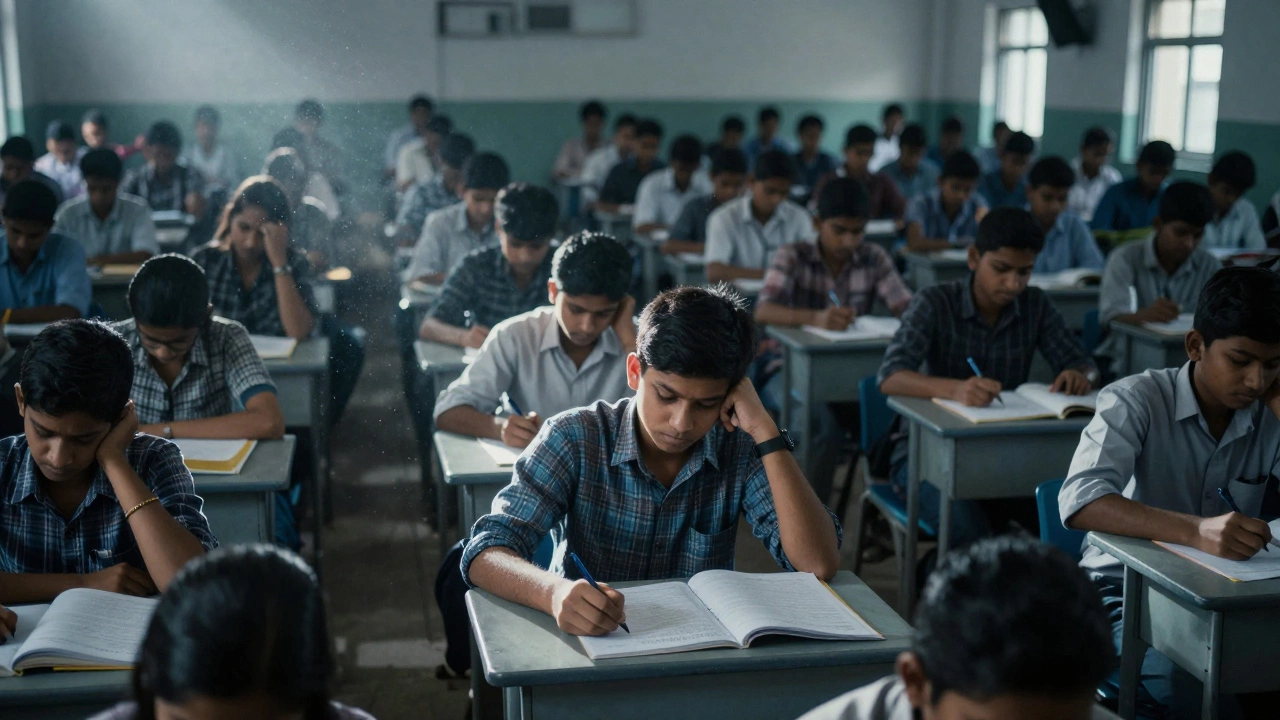
Toughness isn’t just intellectual; it’s psychological. The typical JEE aspirant spends 12 to 14 hours a day studying for two years. This includes school, coaching classes, self-study, and mock tests. The burnout rate is high.
In Bangalore, where I live, the culture around JEE is intense. Coaches like Allen, Resonance, and FIITJEE dominate the landscape. Students follow a rigid schedule: wake up at 6 AM, attend lectures, solve problem sets until midnight, sleep for 5 hours, repeat. This lifestyle is unsustainable for many. The mental toll is a significant part of why the exam is perceived as "the toughest."
Furthermore, the pattern changes every year. JEE Advanced often introduces new question formats-integer-type answers, paragraph-based questions, or matrix-match types. These test your adaptability under pressure. One wrong guess can cost you marks due to negative marking. This forces you to be not just smart, but precise.
Comparing JEE with Other Major Exams
To truly gauge difficulty, let’s put JEE side-by-side with other elite Indian exams.
| Exam | Primary Skill Tested | Preparation Duration | Key Challenge |
|---|---|---|---|
| IIT JEE Advanced | Problem Solving, Logic | 2 Years (Intensive) | Depth of Concepts, Speed |
| NEET UG | Memory, Application | 2 Years | Vast Syllabus, Accuracy |
| UPSC CSE | Analysis, General Knowledge | 3-5 Years (Often) | Breadth of Knowledge, Interview |
| CLAT | Reading Comprehension, Logic | 1 Year | Speed Reading, Legal Aptitude |
Notice that UPSC doesn’t have a fixed cutoff. The number of vacancies varies yearly, and the interview stage adds a subjective element. JEE is objective. Your rank is determined purely by your score. This objectivity makes JEE "fairer" in some ways, but also more ruthless. There’s no room for error.

Strategies to Crack the Beast
If you’re considering taking the plunge, here’s what actually works. Forget the myth that you need to study 18 hours a day. Consistency beats intensity.
- Master NCERT First: Especially for Chemistry and basic Physics/Math concepts. Don’t skip fundamentals. Many JEE Advanced questions are twisted versions of NCERT examples.
- Practice Previous Year Questions (PYQs): Solve the last 10 years of JEE Main and Advanced papers. Understand the trend. Notice how certain topics repeat.
- Analyze Mock Tests: Taking a test is useless if you don’t analyze it. Spend 2 hours analyzing a 3-hour test. Identify why you got a question wrong: silly mistake, concept gap, or time management?
- Balance Subjects: Don’t ignore Inorganic Chemistry because it’s "boring." It’s the easiest section to score full marks in if you memorize the right things.
- Mental Health Matters: Take breaks. Exercise. Sleep. A tired brain makes stupid mistakes. JEE is a marathon, not a sprint.
Is It Worth It?
The brand value of an IIT degree is undeniable. Alumni networks, placement packages, and global recognition are powerful perks. But remember, JEE is not the only path to success. NITs, IIITs, and private universities like BITS Pilani and VIT offer excellent education and placements.
The "toughest" label is partly marketing. It creates urgency and drives the coaching industry. While the exam is undeniably challenging, it’s conquerable with the right strategy. Don’t let the fear paralyze you. Let the challenge motivate you.
Is JEE Advanced harder than JEE Main?
Yes, significantly. JEE Main tests breadth and speed, covering standard textbook concepts. JEE Advanced tests depth, requiring multi-concept integration and higher-order thinking skills. Many students who score well in JEE Main struggle with the complexity of JEE Advanced.
Can I crack JEE in one year of preparation?
It is possible, especially if you have a strong foundation from Class 11. However, it requires extreme discipline, 10-12 hours of focused study daily, and efficient resource management. Droppers (students who take a gap year) often have an advantage due to extra time, but freshers can succeed with intense focus.
Which subject is the hardest in JEE?
Subjectively, Mathematics is often cited as the hardest due to its vast syllabus and unpredictable question patterns. However, Physics can be tough for students weak in conceptual visualization, while Inorganic Chemistry challenges those who dislike rote learning. It depends on your individual strengths.
Do I need coaching to crack JEE?
Not necessarily. Many toppers are self-prepared. Coaching provides structure, peer competition, and curated material, which helps. But if you are disciplined, you can use online resources, NCERT books, and standard reference texts (like HC Verma for Physics) to prepare effectively without joining a physical institute.
What is the best rank needed for a top branch in IIT Bombay?
For Computer Science Engineering (CSE) in IIT Bombay, you typically need an All India Rank (AIR) under 100-150. For other core branches like Mechanical or Electrical, ranks between 200-500 are usually sufficient. Ranks vary slightly each year based on paper difficulty and seat matrix changes.