PHP vs JavaScript Task Selector
Select a Task
Choose from common web development tasks to see whether PHP or JavaScript is the right tool for the job. PHP handles server-side logic while JavaScript handles client-side interactivity.
Analysis Result
PHP isn’t something you use to make buttons glow or menus slide in-that’s JavaScript’s job. PHP runs quietly on the server, handling data, talking to databases, and sending back HTML to your browser. If you’ve ever filled out a login form and saw your name appear on the next page, PHP likely pulled your info from a database behind the scenes. It’s not flashy, but it’s the backbone of over 77% of websites that use a server-side language, including big names like WordPress, Wikipedia, and Facebook (in its early days).
What PHP Actually Does
PHP stands for Hypertext Preprocessor. It’s a server-side scripting language, which means it runs on the web server before anything reaches your browser. When you type example.com/login, your browser asks the server for that page. The server sees the request, runs the PHP code on that page, and only then sends back clean HTML, CSS, and JavaScript to your screen.
Think of it like a kitchen. You order a burger. The chef (PHP) takes your order, grabs the ingredients (data from a database), cooks it (processes the logic), and hands you the finished meal (HTML page). You never see the stove, the onions, or the grill-just the burger. That’s PHP. It works behind the scenes.
PHP handles tasks like:
- Verifying user logins and passwords
- Storing form data in a database like MySQL
- Generating dynamic content based on who’s viewing the page
- Managing sessions-like keeping you logged in as you browse
- Connecting to APIs to pull in weather, payments, or maps
None of this happens in your browser. That’s why you can’t see PHP code when you right-click and "View Page Source." You’ll only see the output: HTML.
Why PHP Isn’t Frontend
Frontend is what users directly interact with: buttons, colors, animations, forms, scrolling effects. That’s built with HTML, CSS, and JavaScript-all running inside the browser. PHP can’t do any of that directly. You can’t write a PHP script that makes a button change color when you hover over it. That’s JavaScript’s job.
Some people get confused because PHP can output HTML. Yes, PHP writes HTML code, but it doesn’t run it. PHP is the writer. JavaScript is the actor. For example:
<?php
  echo "<p>Welcome, " . $username . "!</p>";
?>
This PHP code generates a paragraph with the user’s name. But once the page loads, that paragraph is just static HTML. No PHP is running anymore. If you want that name to update without reloading the page, you need JavaScript.
PHP is like a ghostwriter. You never see them. You only see the book.
Where PHP Fits in a Real Website
Let’s say you’re building a simple blog. Here’s how the pieces fit:
- You visit mysite.com/blog.
- Your browser asks the server for that page.
- The server finds blog.php and runs it.
- PHP connects to a MySQL database and pulls the latest 10 blog posts.
- PHP wraps each post in HTML, adds titles, dates, and author names.
- PHP sends the finished HTML page to your browser.
- Your browser displays it. JavaScript might make the menu sticky or load comments without refreshing.
PHP does the heavy lifting: fetching, filtering, organizing. JavaScript makes it feel alive. Frontend tools make it look good. PHP doesn’t compete with them-it enables them.

Common Misconceptions
Some beginners think PHP is frontend because they see it in the same folder as HTML files. Or they assume all code in a website is "frontend." But location doesn’t define function. A chef’s recipe book is in the kitchen, but it’s not the food.
Another myth: "PHP can do everything now." True, PHP can output JSON for APIs, and with frameworks like Laravel, it can feel more modern. But even then, it’s still running on the server. If you’re building a single-page app with React or Vue, PHP might still handle the API endpoint-but the frontend framework handles the interface.
And no, you can’t run PHP in the browser. Not without a server. Even tools like PHP Desktop or Electron wrap PHP inside a server environment. It’s still server-side.
PHP vs JavaScript: Who Does What?
Here’s a simple breakdown:
| Task | PHP | JavaScript |
|---|---|---|
| Runs on | Server | Browser |
| Handles user login | Yes - checks password against database | No - only sends data to server |
| Updates page without reload | No | Yes - via AJAX or fetch |
| Connects to databases | Yes - MySQL, PostgreSQL, etc. | No - browser can’t directly access databases |
| Creates animations | No | Yes - with CSS transitions or libraries |
| Generates dynamic HTML | Yes - outputs HTML based on data | Yes - modifies DOM after page loads |
PHP and JavaScript aren’t rivals-they’re teammates. PHP builds the structure and security. JavaScript adds interactivity.
When You Might Use PHP Today
PHP isn’t dead. It’s still the engine behind 77% of websites using server-side languages (W3Techs, 2025). Here’s where you’ll still find it:
- WordPress sites - over 43% of all websites use WordPress, and it’s built on PHP.
- Small business websites - cheap hosting, easy setup, no need for complex Node.js or Python setups.
- E-commerce with WooCommerce - runs on WordPress, so PHP is handling orders, inventory, and payments.
- Legacy systems - banks, government portals, schools still run PHP apps from the 2000s.
- API backends - Laravel and Symfony let PHP serve JSON to mobile apps or React frontends.
If you’re starting out and want to build a simple site fast, PHP with WordPress is still one of the easiest paths. You don’t need to learn React, Webpack, or Babel. Just install WordPress, pick a theme, and go.
What to Learn Next
If you’re learning PHP, here’s a practical roadmap:
- Learn basic PHP syntax: variables, loops, conditionals
- Connect to MySQL:
mysqlior PDO - Build a simple contact form that saves data to a database
- Learn how sessions work (keeping users logged in)
- Then learn JavaScript to make your forms feel responsive
- Finally, explore Laravel if you want modern structure and security
Don’t try to learn everything at once. Master PHP as the server-side tool it is. Then layer JavaScript on top for interactivity. That’s how real websites are built.
Final Answer: PHP Is Backend
PHP is backend. Not because it’s old. Not because it’s boring. But because it runs on the server, handles data, and sends output to the browser. It doesn’t touch the user interface directly. It doesn’t animate, validate forms in real time, or respond to clicks. That’s frontend.
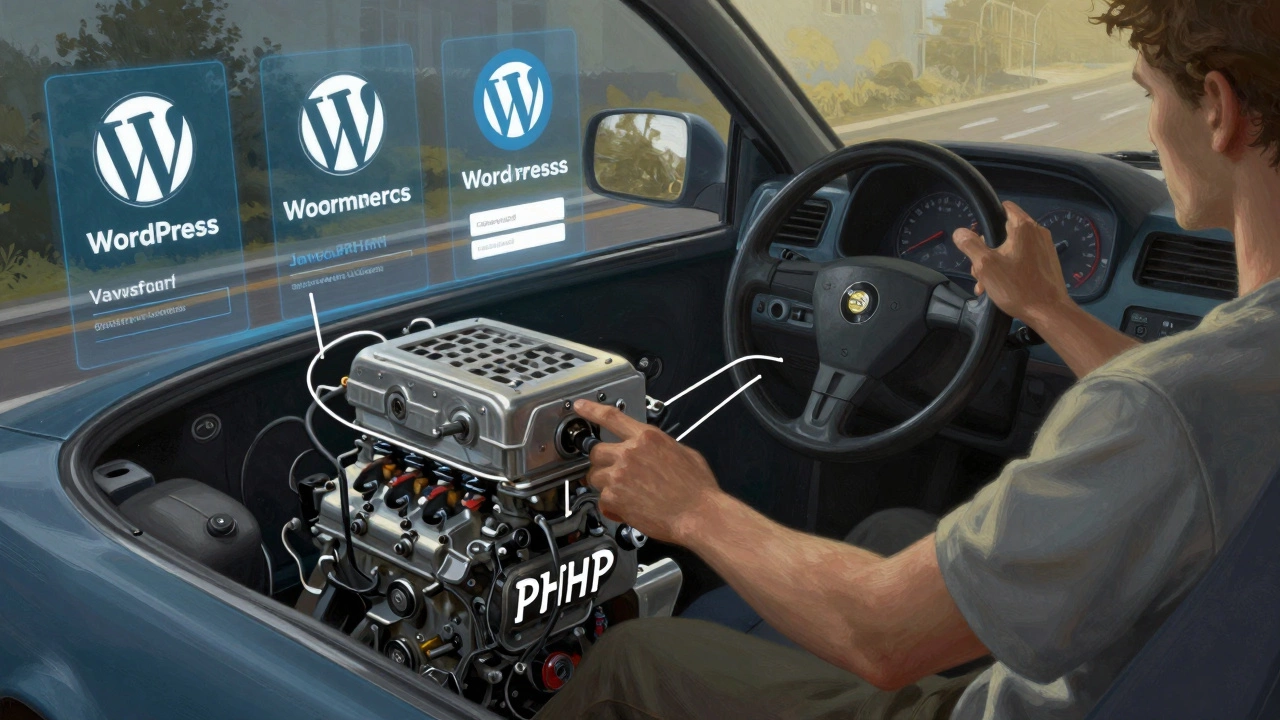
Think of it this way: If your website were a car, PHP would be the engine. JavaScript would be the steering wheel and dashboard. You need both. But one powers it. The other lets you drive it.
So if someone asks you, "Is PHP frontend or backend?"-the answer is simple: backend. And that’s exactly where it belongs.
Can PHP be used for frontend development?
No, PHP cannot be used for frontend development. Frontend development requires code that runs in the browser, like HTML, CSS, and JavaScript. PHP runs on the server and only outputs HTML, CSS, or JavaScript as text. You can’t make buttons respond to clicks or animate elements with PHP alone. It’s a server-side language by design.
Why do people think PHP is frontend?
People confuse PHP with frontend because PHP files often have .php extensions and are stored alongside HTML files. Since PHP generates HTML, it’s easy to assume it runs in the browser. But that’s like thinking a printer is part of the document-it creates the output, but doesn’t display it. The browser only sees the final HTML, not the PHP code that made it.
Is PHP still relevant in 2026?
Yes, PHP is still very relevant. Over 77% of websites using a server-side language rely on PHP, according to W3Techs 2025 data. WordPress, which powers 43% of all websites, is built on PHP. Laravel and Symfony keep PHP modern for API-driven apps. While newer languages like Node.js are growing, PHP remains the most accessible option for small businesses, blogs, and e-commerce sites.
Can PHP and JavaScript work together?
Absolutely. PHP handles server-side logic like user authentication and database queries. JavaScript handles client-side interactivity like form validation, dynamic content updates, and animations. For example, PHP might fetch a list of products from a database and send it as JSON. JavaScript then takes that JSON and displays it on the page without reloading. They’re designed to work together.
Do I need to learn PHP if I’m learning React or Vue?
Not necessarily-but you’ll still need a backend. React and Vue are frontend frameworks. They need data from somewhere. That’s where PHP (or Node.js, Python, etc.) comes in. You can use PHP to build the API that your React app calls. Many developers use PHP for the backend and React for the frontend. Learning PHP gives you full-stack control, even if your main focus is frontend.
What’s the easiest way to start with PHP?
Install XAMPP or Local by Flywheel on your computer. They give you a local server with PHP and MySQL built in. Then create a simple file called hello.php with <?php echo "Hello World"; ?>. Open it in your browser through localhost/hello.php. That’s your first PHP page. From there, build a contact form that saves data to a database. That’s 80% of what most websites need.