Full Stack Developer Learning Time Calculator
Estimate your path to becoming a junior full stack developer based on weekly study hours. The article suggests 6-9 months with 15-20 hours/week of focused learning.
If you’ve ever looked at a website and thought, "I want to build something like that," but you’ve never written a single line of code - you’re not alone. Thousands of people start every year with zero experience and end up working as full stack developers. It’s not magic. It’s a path. And it’s doable, even if you’re starting from scratch.
What Does a Full Stack Developer Actually Do?
A full stack developer works on both the front end (what users see) and the back end (what happens behind the scenes). Think of it like building a house. The front end is the paint, windows, and furniture. The back end is the plumbing, wiring, and foundation. A full stack developer handles both.
On the front end, you’ll use HTML, CSS, and JavaScript to make buttons work, forms submit, and pages look good on phones. On the back end, you’ll use a language like Python, Node.js, or Ruby to manage data, connect to databases, and handle user logins. You’ll also need to know how to deploy your app so others can use it online.
It sounds like a lot - and it is. But you don’t need to master everything at once. You build it piece by piece.
Step 1: Start with HTML and CSS
Before you write a single line of JavaScript, learn how to structure a webpage. HTML is the skeleton. CSS is the skin. Together, they make everything look clean and organized.
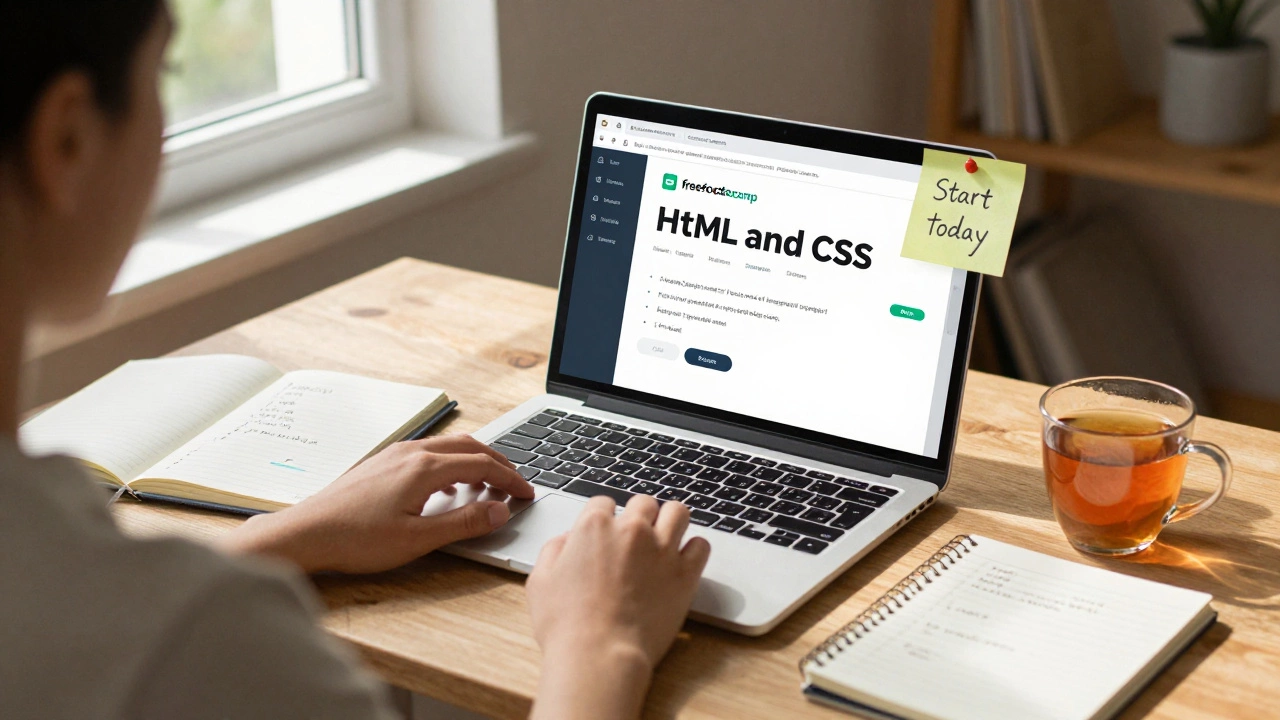
Try this: Open your browser, go to freeCodeCamp, and do their free HTML and CSS course. It takes about 10 hours. You’ll build a simple portfolio page, a recipe card, and a responsive navigation bar. By the end, you’ll understand how to make a webpage look professional - even if you’ve never coded before.
Don’t skip this step. Many beginners jump into JavaScript too fast and get lost. Solid HTML and CSS are the foundation. Without them, nothing else sticks.
Step 2: Learn JavaScript - The Engine of the Web
JavaScript is what makes websites interactive. It’s the reason your menu drops down, your cart updates without refreshing, and your login form checks if you typed an email correctly.
Start with the basics: variables, functions, loops, and conditionals. Then move to DOM manipulation - how JavaScript talks to HTML and CSS. After that, learn how to fetch data from APIs (like getting weather info or user profiles).
Build small projects: a to-do list, a calculator, a quiz game. These aren’t fancy, but they teach you how to think like a developer. Use Codewars for practice problems. Solve one a day. It’s like lifting weights for your brain.
Step 3: Pick a Frontend Framework - React or Vue
Once you’re comfortable with JavaScript, it’s time to learn a framework. React is the most popular. Vue is simpler to start with. Both help you build complex interfaces faster.
React is used by companies like Facebook, Netflix, and Airbnb. Vue is loved by startups and smaller teams because it’s lightweight. Pick one and stick with it.
Do the official React tutorial (it’s free on their website). Build a weather app that pulls data from a public API. Then build a movie search app. These projects will teach you state management, components, and how real apps are structured.
Step 4: Learn a Backend Language - Node.js or Python
Now you know how to make things look good. Time to learn how to make them work.
Node.js lets you use JavaScript on the server. If you already know JS, this is the easiest path. Python (with Django or Flask) is more beginner-friendly and used by Instagram, Dropbox, and Reddit.
Start with Node.js: Learn how to set up a server, handle HTTP requests, and connect to a database. Build a simple blog where users can post and delete stories. Use MongoDB for the database - it’s JSON-based, so it’s easy to understand if you already know JavaScript.
Or go with Python: Install Flask, create a login system, and store user data in SQLite. It’s simpler than Node.js if you’re new to programming.
Either way, you’ll learn about REST APIs, authentication, and how data flows between the front end and back end.
Step 5: Connect Frontend and Backend - Build Your First Full Stack App
Now you’ve got front end skills and back end skills. Time to put them together.
Build a task manager: Users sign up, create tasks, mark them as done, and see them saved in a database. The front end is React. The back end is Node.js. The database is MongoDB. You’re now a full stack developer.
Don’t worry if it’s messy. First versions always are. The goal isn’t perfection - it’s completion. Finish one full project. Then build another. And another.
Step 6: Learn Git and Deploy Your Apps
Code without version control is like writing a letter and never saving it. You’ll lose everything if something breaks.
Learn Git basics: git init, git add, git commit, git push. Create a free GitHub account. Put every project you build there. It’s your portfolio.
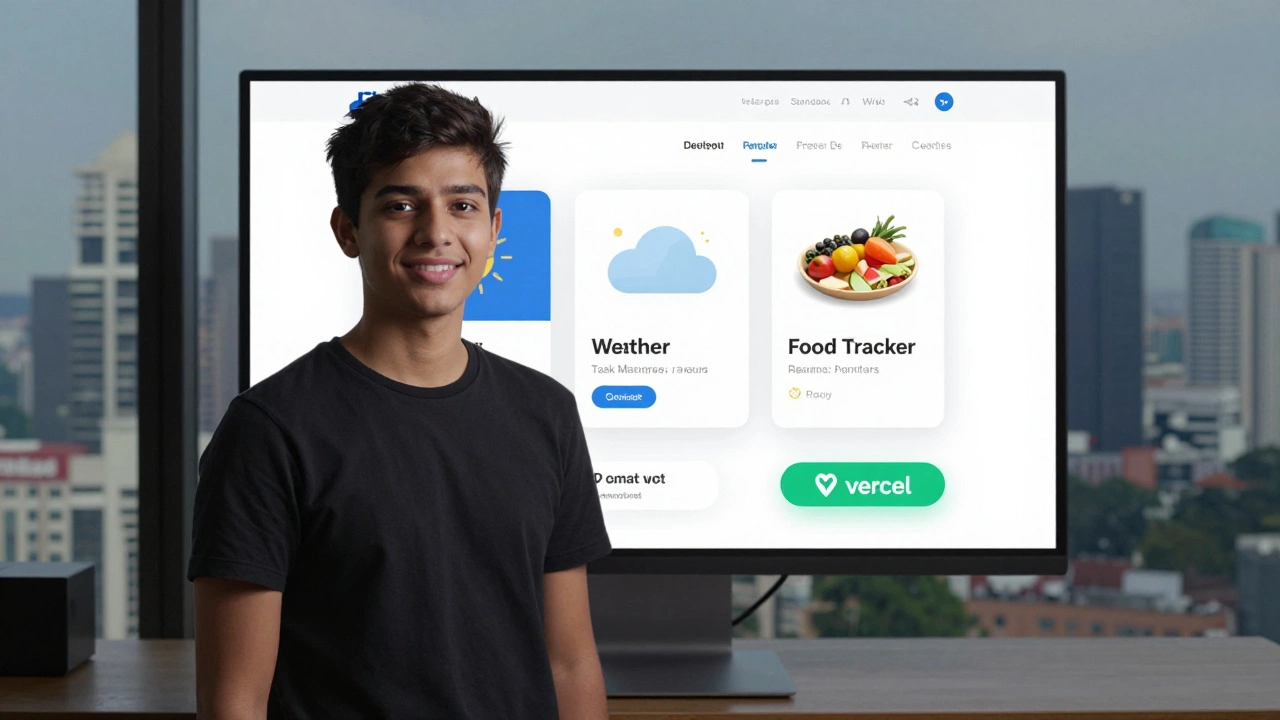
Then deploy your apps. Use Vercel for frontend (free, one-click). Use Render or Heroku for backend (free tiers available). Seeing your app live online is the best motivator. Friends will use it. You’ll feel real pride.
Step 7: Build a Portfolio - Not a Resume
Employers don’t care about your degree. They care about what you’ve built.
Create a simple portfolio website (yes, you can build it yourself). Show three projects:
- A front-end project (like a weather app)
- A full-stack project (like a task manager)
- A project that solves a real problem (like a local food delivery tracker for your city)
Each project needs:
- A live link
- A GitHub repo
- A short description: What problem did it solve? What did you learn?
That’s it. No need for fancy designs. Just clear, working code.
Step 8: Apply for Junior Roles - Even If You Feel Unready
You don’t need to know everything to get hired. Companies hire juniors because they know they’ll grow.
Look for titles like:
- Junior Full Stack Developer
- Frontend Developer (with backend learning)
- Web Developer Intern
Apply to startups. They’re more open to no-experience hires. In Bangalore, companies like Razorpay, Zomato, and Dunzo hire juniors regularly.
Prepare for interviews by practicing: “Tell me about a project you built.” “How did you handle a bug?” “What did you learn?” Be honest. Say, “I didn’t know this, so I learned it.” That’s what they want to hear.
Keep Learning - It Never Stops
Full stack development isn’t a finish line. It’s a journey. After your first job, you’ll learn Docker, CI/CD, cloud services, testing, and more. But that’s the point. You’re not just learning to code. You’re learning to solve problems.
Join local meetups. Follow developers on Twitter. Watch YouTube tutorials. Build something new every month. The more you build, the more confident you become.
There’s no secret formula. Just consistency. Code every day. Even for 30 minutes. Over time, it adds up.
Common Mistakes to Avoid
- Trying to learn everything at once - focus on one thing until you’re comfortable.
- Watching tutorials without building - you learn by doing, not by watching.
- Comparing yourself to others - everyone starts somewhere. Your pace is yours.
- Waiting for the "perfect" time to start - today is the best day.
The biggest mistake? Giving up before you’ve even started.
Can I become a full stack developer without a computer science degree?
Absolutely. Most full stack developers today didn’t study CS. Companies care about what you can build, not your diploma. A strong portfolio with real projects matters more than a degree.
How long does it take to become a full stack developer with no experience?
If you study 15-20 hours a week, you can land your first job in 6 to 9 months. Some do it in 4 months with intense focus. Others take a year. It depends on how much time you put in, not how smart you are.
Do I need to learn all programming languages?
No. Learn one frontend framework (React), one backend language (Node.js or Python), and one database (MongoDB or PostgreSQL). That’s enough to get started. You’ll pick up others later.
Is it too late to start if I’m over 30?
Not at all. Many developers switch careers in their 30s, 40s, and even 50s. Age doesn’t matter. Persistence does. I’ve seen teachers, nurses, and chefs become developers - and they’re some of the best.
What’s the salary for a junior full stack developer in India?
In cities like Bangalore, Hyderabad, or Pune, junior full stack developers earn between ₹3.5 lakh and ₹6 lakh per year. With 1-2 years of experience, that jumps to ₹8-12 lakh. The demand is high, and companies are willing to train juniors.
Next Steps
Start today. Open your laptop. Go to freeCodeCamp. Do the first HTML lesson. That’s it. No need to plan. No need to wait. Just begin.
Build one small thing. Then another. Keep going. In six months, you’ll look back and wonder why you didn’t start sooner.