
Daily English Speaking Tracker
Your 45-Minute Practice Routine
Based on the article's recommended daily routine
Your Achievements
If you want to speak English but don’t have the time or money for classes, you’re not alone. Millions of people around the world are doing it right now-on their own, with no teacher, no classroom, and sometimes no native speaker nearby. It’s not magic. It’s not about being born with a talent for languages. It’s about consistent practice and smart habits. You don’t need to memorize grammar rules or write essays. You need to talk. And the good news? You can start talking today, even if you only know ten words.
Start by Listening Like a Native Speaker
Most people think learning to speak means memorizing vocabulary. But if you can’t understand how words sound when real people say them, you’ll never sound natural. Start by listening to English every day-not just for 10 minutes, but for at least 30. Use podcasts, YouTube channels, or TV shows you already like. Pick one show, like Friends or The Crown, and watch one episode a day. Don’t use subtitles at first. Just listen. Let your brain get used to the rhythm. After a week, turn on English subtitles. Then, after two weeks, try turning them off again. You’ll start catching words you didn’t hear before.Don’t just listen passively. Repeat what you hear. Pause the video. Say the sentence out loud. Copy the tone, the pauses, even the way someone laughs between sentences. This is called shadowing. It’s not about perfection. It’s about training your mouth and ears to work together. Do this for 10 minutes every morning. In 30 days, you’ll notice your pronunciation changing without even trying.
Speak Even When You’re Afraid
The biggest blocker isn’t grammar. It’s fear. Fear of making mistakes. Fear of sounding silly. But here’s the truth: every fluent English speaker made thousands of mistakes before they got good. You have to do the same.Start small. Talk to yourself. Describe what you’re doing. “I’m making tea. The water is boiling. I’m adding sugar.” Say it out loud. Do it while brushing your teeth. While walking to the bus stop. While waiting for your coffee. This builds confidence. It trains your brain to think in English, not translate from your first language.
Next, find someone to talk to. Not a teacher. Not a tutor. Just someone who’s also learning. Use free apps like Tandem or HelloTalk. Find a partner in Canada, Australia, or Kenya. You teach them your language. They teach you English. No pressure. No grades. Just real conversation. Even 15 minutes a day adds up. In three months, you’ll be having full conversations about your day, your food, your favorite movies.
Use Real-Life Words, Not Textbook Phrases
Textbooks teach you things like “I would like to purchase a ticket.” Real people say “Can I get a ticket?” or “Got one, please?” You don’t need to sound polite. You need to sound like someone who belongs.Learn phrases, not just words. For example:
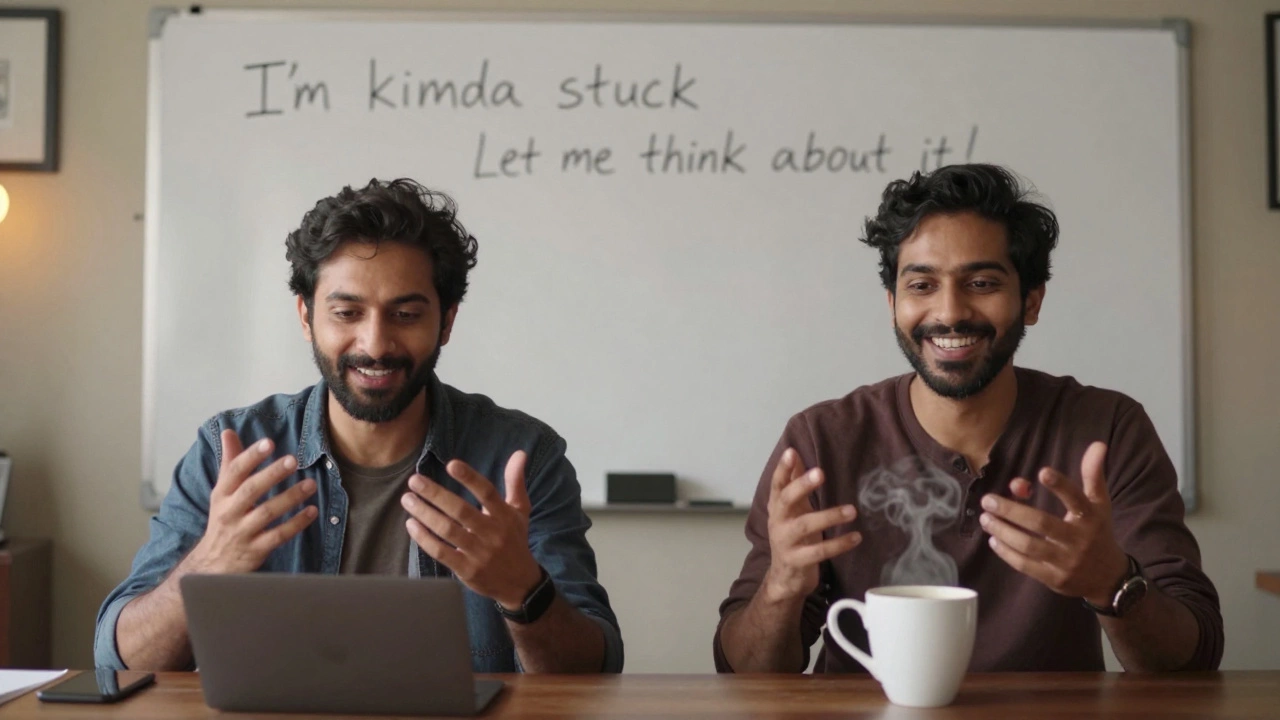
- “I’m kinda stuck on this.” (instead of “I am having difficulty with this”)
- “Let me think about it.” (instead of “I require time to consider”)
- “That’s not my thing.” (instead of “That does not align with my interests”)
Write down 5 new phrases every week. Say them out loud. Use them in your head. Try them out with your language partner. When you start using these, people will notice. They’ll say, “You sound so natural.” That’s when you know you’re moving from textbook English to real English.
Build Your Own Speaking Routine
You don’t need a course. You need a routine. Here’s a simple one that works for thousands of learners:- Morning (10 min): Shadow a short audio clip from a podcast or video.
- Afternoon (5 min): Talk to yourself about your day. Record it on your phone.
- Evening (15 min): Have a real conversation with a language partner.
- Weekly (30 min): Watch a YouTube video on how to pronounce tricky sounds (like “th” or “r”). Practice them for 5 minutes.
That’s 45 minutes a day. Less than the time you spend scrolling Instagram. And in 60 days, you’ll be speaking without overthinking. In 90 days, you’ll be thinking in English.
Track Your Progress-Not Your Mistakes
Don’t compare yourself to native speakers. You’re not trying to be them. You’re trying to be understood. Keep a simple log. Every Sunday, write down:- One thing you said clearly this week
- One new phrase you used
- One person who understood you
Look back after three months. You’ll be shocked. You’ll see how far you’ve come. Progress isn’t loud. It’s quiet. It’s the moment you realize you didn’t need to translate in your head. It’s the laugh you shared with someone because you understood their joke. That’s fluency.
What to Avoid
There are traps that slow you down. Don’t fall for them:- Don’t wait until you’re “ready.” There’s no such thing. You learn by doing.
- Don’t memorize long lists of vocabulary. You’ll forget them. Use words in context instead.
- Don’t rely on translation apps. They help with writing, not speaking. They make you think in your language, not English.
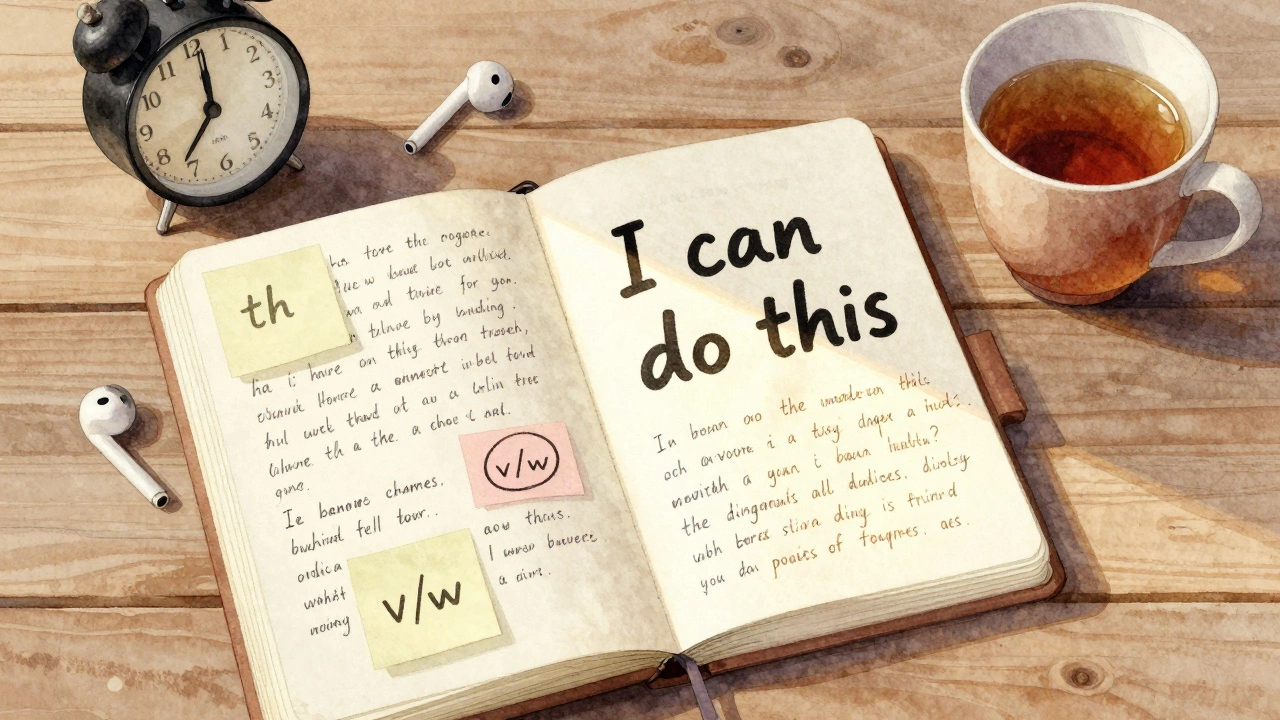
- Don’t skip the hard sounds. “Th,” “v” vs “w,” “l” vs “r”-practice them daily. They’re the difference between being understood and being misunderstood.
You Don’t Need Perfect English. You Need Confident English.
Fluency isn’t about grammar. It’s about connection. It’s about being able to say what you mean, when you mean it. You don’t need to know every tense. You just need to say “I went,” “I’m going,” and “I will go.” And mean it.People don’t care if you say “I seen it.” They care if you say it with a smile. If you’re clear, if you’re honest, if you’re trying-that’s all that matters. English is not a test. It’s a tool. And you’re building it, one word, one sentence, one conversation at a time.
Start today. Not tomorrow. Not next week. Today. Say one thing out loud. Even if it’s just “I can do this.” Say it again tomorrow. And the next day. Keep going. You don’t need a classroom. You just need to open your mouth.
Can I learn to speak English without going to a class?
Yes. Thousands of people learn to speak English without ever stepping into a classroom. The key is consistent, daily practice-listening, repeating, and talking. Use free resources like podcasts, YouTube, and language exchange apps. Focus on speaking, not grammar. Progress comes from use, not study.
How long does it take to speak English fluently?
It depends on how much time you put in. If you practice 30-45 minutes a day, you’ll notice clear improvement in 60 days. Real fluency-where you think in English without translating-usually takes 6 to 9 months. But you can have full conversations in as little as 3 months if you talk every day.
What’s the best app to learn speaking English?
For speaking practice, Tandem and HelloTalk are the best. They connect you with real people who want to learn your language. You talk for 15 minutes in English, then 15 minutes in your language. No bots. No lessons. Just real talk. For listening, try BBC Learning English or VOA Learning English on YouTube. They speak slowly and clearly.
Should I learn grammar first?
No. Learn grammar as you go. Focus on speaking first. When you say something wrong, notice it. Then look up the rule. For example, if you say “I go to school yesterday,” you’ll learn past tense naturally. This way, grammar sticks because it solves a problem you actually had.
I’m shy. How do I start talking?
Start by talking to yourself. Describe your room. Talk about what you ate. Record yourself. Listen. Then try a 5-minute chat with a language partner on Tandem. Most people are learning too. They’re nervous too. You’re not alone. The first time is the hardest. After that, it gets easier.