Web Development Learning Path Calculator
Your Current Status
Estimated Time to Job Readiness
Recommended Roadmap
Select your details and click calculate to see your personalized learning timeline.
You have probably heard the old-school advice: "Learn C++ first. It teaches you how computers actually work." Then you look at your goal-building interactive websites or modern apps-and wonder if you really need to spend six months debugging memory leaks before you can make a button change color. The short answer is no. JavaScript does not require C++. In fact, starting with C++ might even slow you down if your immediate goal is web development.
I see this question pop up constantly in developer forums and Discord servers here in Bangalore. Beginners are often intimidated by the sheer volume of languages available. They think there is a strict hierarchy where C++ sits at the top as the "father" of all logic. While C++ is powerful, it belongs to a different family tree than the language you want to learn. Let’s break down why you don’t need it, what you should focus on instead, and when C++ might actually be useful later in your career.
The Family Tree: Why C++ and JavaScript Are Different
To understand why C++ isn’t a prerequisite, you need to look at their lineage. C++ is a statically-typed, compiled systems programming language created by Bjarne Stroustrup in 1979. It is known for its performance and direct hardware access. On the other hand, JavaScript is a dynamically-typed, interpreted scripting language primarily used for web interactivity, created by Brendan Eich in 1995.
They share almost nothing in terms of syntax or daily workflow. C++ forces you to declare variable types explicitly (like `int age = 25;`). JavaScript lets you just say `let age = 25;` and figures it out. If you start with C++, you will develop habits that you have to unlearn when switching to JavaScript. For example, C++ relies heavily on manual memory management using pointers. JavaScript uses automatic garbage collection. You literally cannot use pointers in standard JavaScript. So, learning C++ first doesn’t give you a head start; it gives you baggage.
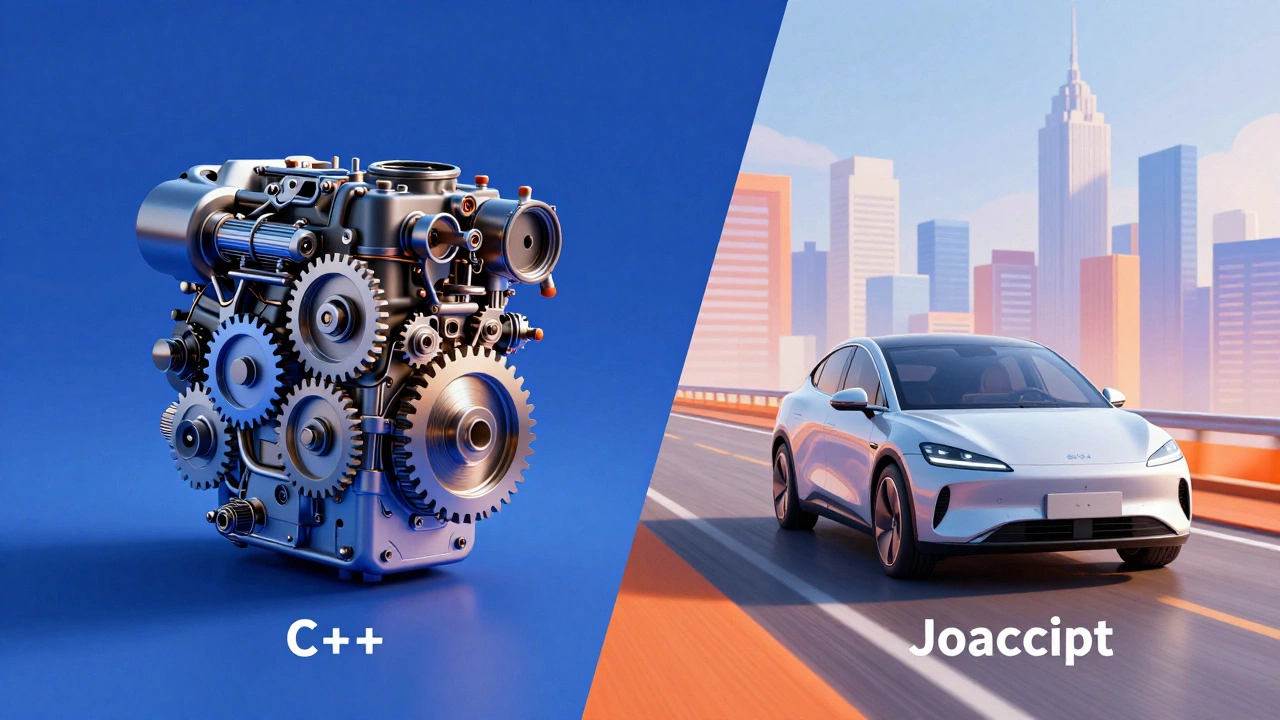
Think of it like learning to drive. C++ is like learning to rebuild an engine from scratch. It teaches you mechanics deeply. JavaScript is like learning to drive a car. You need to know how to steer and brake, but you don’t need to know how the fuel injection works to get from point A to point B. Unless you plan to become an engine mechanic, skip the engine rebuild.
| Feature | C++ | JavaScript |
|---|---|---|
| Type System | Static (must declare types) | Dynamic (types inferred) |
| Execution | Compiled to machine code | Interpreted/JIT compiled by browser |
| Memory Management | Manual (new/delete) | Automatic (Garbage Collection) |
| Primary Use Case | Systems, Games, High-Performance Apps | Web Frontend & Backend (Node.js) |
| Learning Curve | Steep | Gentle initially, complex later |
What You Actually Need to Learn First
If C++ is off the table, what should you study? The path to becoming a competent JavaScript developer is well-defined and doesn’t involve low-level systems programming. Your foundation should rest on three pillars: HTML, CSS, and JavaScript itself.
HTML is the standard markup language for documents designed to be displayed in a web browser. It provides the structure. CSS is a style sheet language used for describing the presentation of a document written in HTML. It handles the look and feel. Without these two, JavaScript has nothing to manipulate. Many beginners try to jump straight into JavaScript because they hear it’s "coding," but HTML and CSS are essential context. You need to understand the Document Object Model (DOM)-the tree-like structure of your webpage-to write effective JavaScript.
Once you grasp the DOM, you can start writing simple scripts. Change a text color. Hide a div element. Fetch data from an API. These tasks are immediate and rewarding. Unlike C++, where you might spend days setting up a compiler environment and linking libraries just to print "Hello World," JavaScript runs instantly in any browser console. This feedback loop is crucial for maintaining motivation.
Here is a practical checklist for your first month:
- Understand semantic HTML tags (
<header>,<article>,<footer>). - Learn CSS Flexbox and Grid for layout design.
- Master basic JavaScript syntax: variables, functions, loops, and conditionals.
- Learn how to select elements using
document.querySelector(). - Practice event listeners (clicks, key presses).
This approach gets you building real things faster. You can create a todo list app within a week. In C++, creating a graphical interface takes significantly more effort and boilerplate code.
When Does C++ Knowledge Help?
So, is C++ useless? Absolutely not. There are specific scenarios where knowing C++ makes you a better JavaScript developer, but these usually apply after you have already mastered JavaScript basics.
First, performance optimization. JavaScript engines like V8 (used in Chrome and Node.js) are written in C++. Understanding how memory works at a lower level helps you write more efficient JavaScript. For instance, knowing why large arrays cause garbage collection pauses can help you optimize your code. But you learn this through JavaScript profiling tools, not by studying C++ textbooks.
Second, WebAssembly (Wasm). This is a technology that allows high-performance code to run in the browser. You can write code in C++, compile it to Wasm, and run it alongside JavaScript. This is huge for games, video editing tools, and scientific simulations in the browser. However, this is an advanced topic. You wouldn’t learn to cook by studying food chemistry first. You learn to cook, then maybe you study chemistry to improve your techniques.
Third, backend infrastructure. Some high-throughput microservices are built in C++ for speed. If you work in fintech or gaming, you might interact with C++ services via APIs. Again, you don’t need to write C++ to consume those APIs. You just need to understand JSON and HTTP requests, which are core JavaScript skills.
Interestingly, while we focus on technical resources, sometimes developers need to unwind or explore different digital directories for various reasons. For instance, some professionals in international hubs like Almaty might browse local service directories such as this resource during downtime, though it has no bearing on coding skills. Back to the code: the point is that specialized knowledge comes later. Stick to the job at hand.

The Myth of "Computer Science Fundamentals"
A common argument for learning C++ is that it teaches "computer science fundamentals." Proponents claim that without understanding pointers, references, and stack vs. heap memory, you aren’t a real programmer. This is elitist nonsense. You can be an excellent engineer without knowing how to manually allocate memory.
Data structures and algorithms-the real core of CS-are best learned in the language you intend to use. Sorting an array in JavaScript is easier to read and debug than sorting a linked list in C++. When you prepare for technical interviews, you will solve algorithm problems in JavaScript. LeetCode and HackerRank support JavaScript natively. You do not need to switch languages to prove your logical thinking skills.
In my experience mentoring junior developers, those who started with C++ often struggled with the asynchronous nature of JavaScript. They were used to linear, synchronous execution. JavaScript is event-driven and non-blocking. This mental model shift is harder for C++ veterans than for beginners who start fresh. Starting with JavaScript allows you to embrace async/await patterns naturally, which are critical for modern web development involving APIs and databases.
Alternative Languages That Might Be More Useful
If you feel you need a second language to broaden your perspective, consider Python or TypeScript instead of C++.
Python is a high-level, general-purpose programming language emphasizing code readability. It shares JavaScript’s dynamic typing and ease of use. Learning Python reinforces concepts like lists, dictionaries, and functions that translate directly to JavaScript objects and arrays. It is also widely used in data science and backend development, making it a versatile companion skill.
TypeScript is a strongly typed superset of JavaScript that compiles to plain JavaScript. This is the closest thing to "learning C++ concepts" but within the JavaScript ecosystem. TypeScript adds static typing to JavaScript. It catches errors early, improves code documentation, and enhances IDE support. Most large-scale JavaScript projects today use TypeScript. Learning TypeScript after you know JavaScript basics is a natural progression. It gives you the safety of static types without the complexity of C++’s compilation model.
| Language | Why Learn It? | Difficulty Jump |
|---|---|---|
| TypeScript | Adds type safety to JS; industry standard | Low |
| Python | Backend, Data Science, AI integration | Low |
| Rust | Memory safety, WebAssembly, systems programming | High |
| C++ | Legacy systems, game engines, high-performance libs | Very High |
Common Pitfalls for JavaScript Beginners
Even without C++, JavaScript has its own traps. Here are the most common ones I see:
- Hoisting confusion: Variables declared with
varare hoisted differently thanletandconst. Always useletandconstunless you have a specific reason not to. - Async/Await misuse: Forgetting to handle errors in asynchronous functions leads to silent failures. Always wrap async calls in try/catch blocks.
- Scope issues: Understanding block scope vs. function scope is critical. Closures are powerful but confusing at first. Practice them deliberately.
- Over-reliance on frameworks: React, Vue, and Angular are great, but they abstract away core JavaScript. Build a few projects with vanilla JavaScript first. It will make you a better framework user later.
These pitfalls are specific to JavaScript. Studying C++ won’t prevent them. In fact, C++ developers often trip over JavaScript’s loose equality operator (==) because they expect strict type checking. Always use strict equality (===) in JavaScript.
Conclusion: Focus on Your Goal
Your time is limited. Every hour spent learning C++ is an hour not spent building a portfolio project in JavaScript. If your goal is to land a job as a frontend or full-stack web developer, C++ is irrelevant to your immediate success. Employers care about what you can build, not what obscure languages you’ve studied.
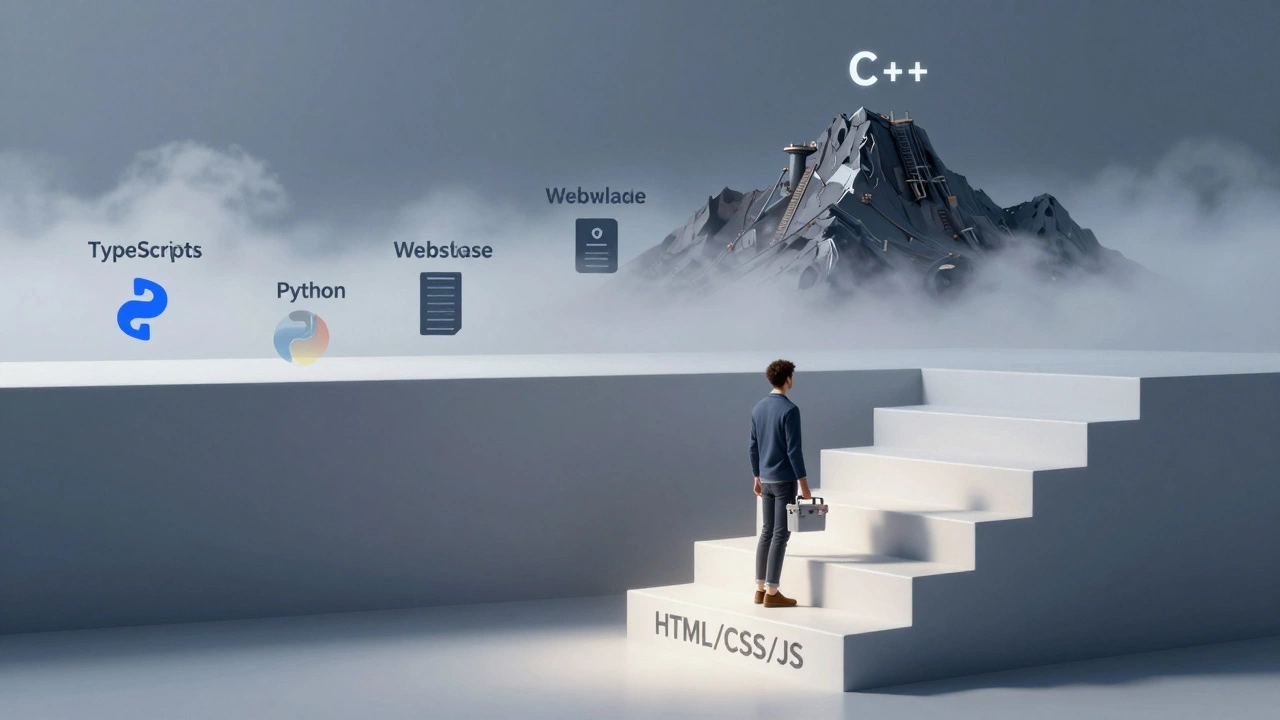
Start with HTML, CSS, and JavaScript. Build small projects. Break them. Fix them. Then move to TypeScript. Once you are comfortable, explore backend technologies like Node.js or databases. Only if you find yourself interested in game development, operating systems, or high-frequency trading should you pick up C++. By then, you’ll appreciate it for what it is: a specialized tool, not a universal foundation.
Remember, the best way to learn programming is by programming. Don’t let gatekeepers convince you that you’re skipping steps. You’re taking the most direct route to your destination. Happy coding!
Can I learn JavaScript without knowing any other programming language?
Yes, absolutely. JavaScript is often recommended as a first language because it runs in every web browser, requires no setup, and provides immediate visual feedback. You do not need prior experience in C++, Java, or Python to start learning JavaScript.
Is C++ harder than JavaScript?
Generally, yes. C++ has a steeper learning curve due to concepts like manual memory management, pointers, and complex compilation processes. JavaScript is more forgiving and easier to pick up initially, though mastering its asynchronous features can be challenging.
Should I learn TypeScript instead of JavaScript?
You should learn JavaScript first. TypeScript is a superset of JavaScript, meaning all valid JavaScript code is also valid TypeScript. Understanding the core JavaScript runtime behavior is essential before adding the layer of type definitions that TypeScript provides.
Does knowing C++ help with JavaScript performance?
Indirectly, yes. Understanding low-level concepts like memory allocation can help you write more efficient JavaScript. However, modern JavaScript engines are highly optimized. For most web applications, writing clean, idiomatic JavaScript is more important than low-level optimizations.
What is the best way to practice JavaScript?
Build projects. Start with simple interactive pages like a calculator or a todo list. Then move to fetching data from public APIs to display weather or news. Finally, clone existing apps like Twitter or Instagram to understand state management and component architecture.