Language Suitability Calculator
Which Programming Language Should You Learn?
Answer a few questions about your goals and learning style to get a personalized recommendation based on real-world data
When you start learning to code, one of the first questions you ask is: JavaScript or C++? Which one is harder? Which one will actually get you a job faster? If you’re coming from zero experience, this isn’t just about syntax-it’s about where you want to go, how fast you want to get there, and what kind of frustration you’re willing to deal with.
JavaScript is forgiving. C++ is unforgiving.
Write this in JavaScript: let x = 5; x = "hello"; and it runs. No error. No crash. The computer just accepts it. Now write the same thing in C++: int x = 5; x = "hello"; and it won’t even compile. You’ll get a long, cryptic error message that makes no sense to a beginner.
This isn’t a bug-it’s a design choice. JavaScript was built for the web, where things need to keep working even if a line breaks. C++ was built for systems programming-where every byte matters and mistakes can crash an airplane’s flight control system.
If you’re learning to build a website, JavaScript lets you see results in minutes. Open a browser, write a line of code, refresh, and there it is: a button that changes color. In C++, you need to install a compiler, set up a project, link libraries, and then you might still get a blank screen. No visual feedback. No instant gratification.
Memory management: C++ makes you do the heavy lifting
One of the biggest reasons people say C++ is harder is memory. In C++, when you create an object with new, you must delete it later with delete. Forget to do it? Your program slowly eats up RAM until it crashes. Do it wrong? You get a segmentation fault-the dreaded "program stopped working" message.
JavaScript? You don’t think about it. You create objects, assign them to variables, and when they’re no longer used, the engine cleans them up automatically. This is called garbage collection. It’s not magic-it’s just done for you. And for someone learning to code, that’s a huge relief.
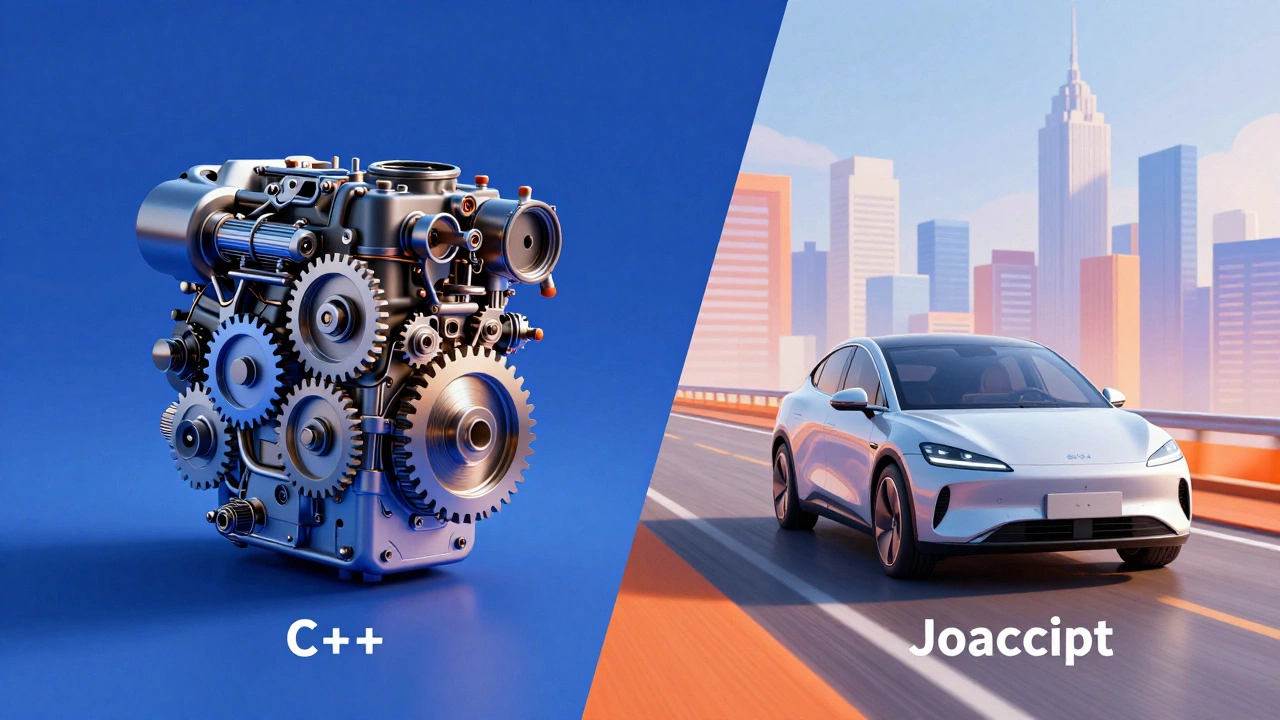
Think of it like driving. JavaScript is an automatic car. You just press the gas and go. C++ is a manual transmission. You have to learn when to shift, when to clutch, how not to stall. Both get you to the destination, but one takes way more effort to start.
JavaScript has a gentle learning curve. C++ has a cliff.
With JavaScript, you can start building real things on day one:
- Make a button that shows an alert
- Change the background color of a webpage
- Fetch weather data from an API
- Build a simple calculator
All of these take less than an hour to code if you follow a beginner tutorial. You’re not just learning syntax-you’re building confidence.
In C++, even the simplest "Hello World" program requires understanding headers, namespaces, streams, and the main function. By the time you get to arrays, you’re already dealing with pointers. Pointers are hard. They’re not just variables-they’re addresses. And if you mess up, your whole program crashes. Many people quit C++ because they hit this wall before they ever got to build something fun.
What you’re actually trying to build matters more than difficulty
Here’s the truth: JavaScript isn’t "easier" because it’s simpler. It’s easier because it’s designed for web interfaces. C++ isn’t harder because it’s more powerful-it’s harder because it’s designed for control.
If you want to build websites, mobile apps, or interactive tools-JavaScript is your path. If you want to build video games, operating systems, or high-performance software-C++ is the tool. But if you’re just starting out, and you don’t know what you want to build yet, JavaScript gives you room to explore.
Most people who start with C++ and get discouraged don’t quit because they’re not smart. They quit because they never got to see the result of their work. With JavaScript, you can make something that works, something that looks cool, something you can show your friends-within hours.

Real-world job demand favors JavaScript
According to the Stack Overflow Developer Survey 2025, JavaScript is the most used programming language in the world. Over 65% of professional developers use it regularly. C++? Around 6%. That’s not because C++ is obsolete-it’s because most jobs today are web-based.
Companies like Google, Facebook, Netflix, and Airbnb all run on JavaScript. Even backend systems use Node.js. You can get hired as a junior developer with just JavaScript, HTML, and CSS. You don’t need a computer science degree. You don’t need to master pointers or memory allocation.
With C++, you’re competing for fewer jobs-mostly in gaming, finance, embedded systems, or robotics. And those jobs usually require a degree, internships, and years of experience. For a beginner, the path is narrower and steeper.
JavaScript has more learning resources
There are thousands of free, beginner-friendly JavaScript tutorials. YouTube videos, interactive sites like freeCodeCamp, Codecademy, and MDN Web Docs-all built for people who’ve never coded before. You can learn by doing, not by reading dense textbooks.
C++ resources? Many are written for university students. They assume you already understand data types, memory, and algorithms. If you’re learning on your own, you’re often stuck trying to decode explanations meant for people who’ve taken a year of CS classes.
One beginner in Bangalore told me: "I tried C++ from a book. After three weeks, I could write a program that added two numbers. But I had no idea how to make it show up on a screen. I felt like I was learning ancient history."
JavaScript is evolving. C++ is stable.
JavaScript changes every year. New features like async/await, modules, and ES2025 additions keep it fresh. That means you’re always learning something new-and the language keeps up with modern needs.
C++ hasn’t changed much in its core since the 1990s. The latest standards (C++20, C++23) add useful tools, but the language still feels like it was designed for punch cards. You still need to manage memory manually. You still need to compile everything. It’s powerful, but it doesn’t feel modern.

So, is JavaScript harder than C++?
No. Not for beginners. Not if your goal is to build something real, see results fast, and get hired.
C++ is harder because it demands more from you before you get any reward. JavaScript gives you rewards early-so you keep going.
That doesn’t mean JavaScript is "better." It just means it’s better for most people starting out. If you’re aiming for game development, embedded systems, or high-frequency trading, C++ is worth the pain. But if you just want to learn how to code, build websites, and maybe get a job in tech-start with JavaScript. You’ll be coding real things in days, not months.
And if you ever decide you want to learn C++ later? You’ll be ahead. You’ll already know how to think like a programmer. The syntax, the logic, the problem-solving-all of that transfers. The hard parts of C++? You’ll be ready for them.
What to do next
If you’re serious about learning JavaScript:
- Go to MDN Web Docs and read the JavaScript guide. It’s free and written by experts.
- Build a simple webpage with a button that changes text when clicked.
- Then add a form that collects your name and displays it on the page.
- After that, try fetching data from a free API like
https://jsonplaceholder.typicode.com/postsand show the titles on your page.
Do that in a week. You’ll know more than 80% of people who "tried" coding and gave up.
What if you already started with C++?
You’re not behind. You’re just on a different path.
If you’re stuck, switch to JavaScript for a month. Build something visual. Get that feeling of "I made this." Then go back to C++ with new confidence. You’ll understand pointers better because you’ve already learned how to solve problems.
Many top engineers started with one language and switched. It’s not failure. It’s strategy.