
Degree Fit Quiz
Find Your Best Degree Match
Answer 3 quick questions to discover which of the 5 easiest online degrees aligns best with your interests, skills, and goals.
What do you enjoy doing in your free time?
What kind of work do you already do well?
What's your end goal?
Your Degree Recommendation
Based on your answers, the is likely the best fit for you.
There’s no such thing as an easiest degree if you’re not willing to show up. But if you’re looking for the least stressful, most manageable path to a diploma-especially while working, raising kids, or juggling other responsibilities-some online degrees stand out. They don’t require advanced math, heavy lab work, or 80-hour weeks. They focus on skills you can learn gradually, with clear steps and real-world use.
What Makes a Degree "Easy"?
"Easy" doesn’t mean no work. It means: low technical barriers, flexible pacing, minimal memorization, and assignments that feel relevant. The easiest online degrees in 2025 share these traits:
- Coursework is mostly reading, writing, and discussion
- No labs, coding, or complex calculations
- Grading is based on participation and essays, not timed exams
- You can finish in 2-3 years part-time without burning out
- Most materials are video-based or text-heavy, not interactive simulations
These aren’t "easy A" degrees. They’re degrees designed for people who want to earn something meaningful without drowning in stress.
Top 5 Easiest Online Degrees in 2025
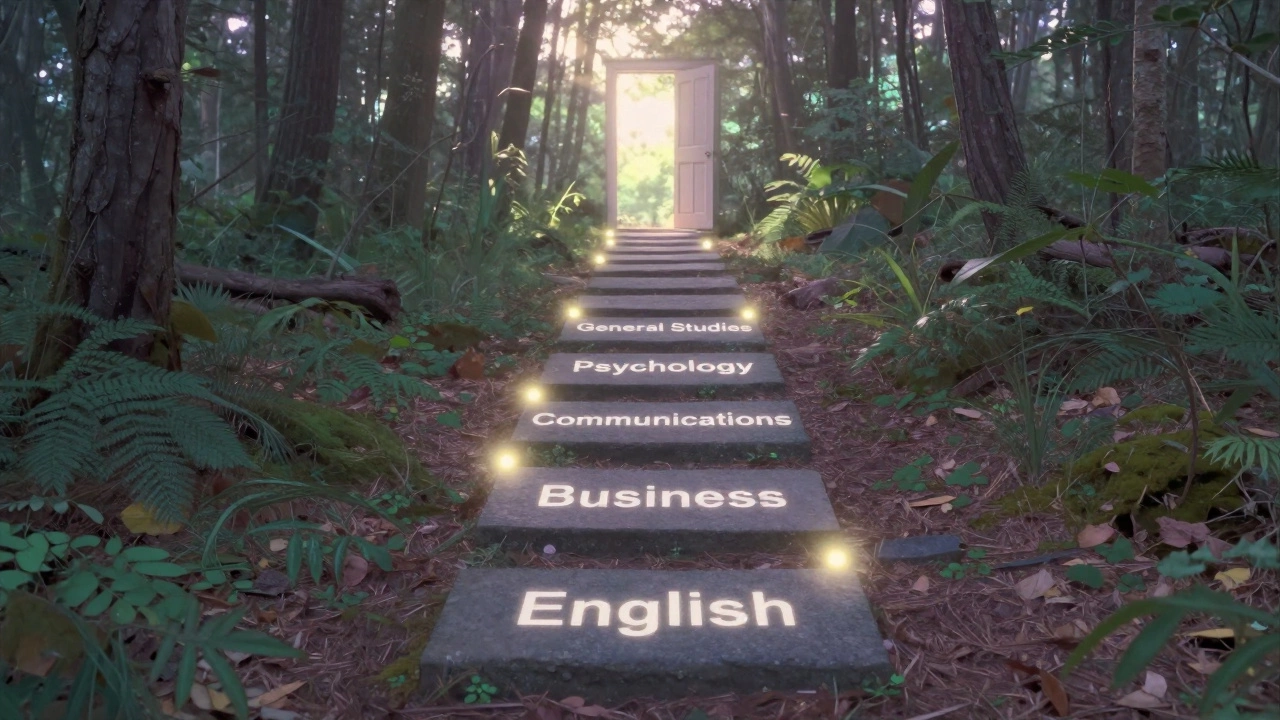
Based on student feedback, completion rates, and curriculum design, here are the five most manageable degrees offered online right now.
1. Associate of Arts in General Studies
This is the most flexible starting point. You pick electives from history, psychology, communications, and sociology. No prerequisites. No major requirements beyond 60 credits. Many students use it to build confidence before transferring to a bachelor’s. It’s perfect if you’re unsure what you want to study. Schools like Southern New Hampshire University and Liberty University offer this with monthly start dates and 100% online coursework.
2. Bachelor of Science in Psychology
Psychology degrees are popular because they focus on human behavior, not memorizing formulas. You read case studies, write reflections, and analyze surveys. There’s no lab work. Most programs use discussion boards where you share opinions on real-life scenarios-like why people procrastinate or how social media affects self-esteem. The hardest part? Keeping up with weekly readings. But if you can read one article a day, you’re set.
3. Bachelor of Arts in Communications
This degree teaches you how to write clearly, speak confidently, and tell stories. Assignments include blog posts, video scripts, press releases, and social media campaigns. No coding. No math. You learn by doing-like creating a campaign for a fake product or interviewing a friend about their job. Many students finish this degree while working in customer service or retail because the skills apply directly to their day job.
4. Associate of Science in Business Administration
Business degrees don’t have to be intimidating. At the associate level, you learn basic accounting (just income vs. expenses), how to write emails, how to schedule meetings, and what a SWOT analysis is. You’ll never balance a balance sheet. You’ll learn how to use Google Sheets to track a small budget. Most assignments are templates you fill out. This is the degree you take if you want to move from receptionist to office manager without going back to school for five years.
5. Bachelor of Arts in English
English majors read novels, poems, and essays. They write about them. That’s it. No multiple-choice tests. No formulas. You get feedback on your writing, not your speed. If you like reading and can write a paragraph without panicking, this is one of the most forgiving degrees online. Many students finish this while working in content roles, tutoring, or even freelance writing. You don’t need to be a literary genius-you just need to show up and write regularly.
What Degrees Look Easy But Aren’t
Some degrees get labeled "easy" because they don’t look technical. But they’re not.
- Nursing (RN-to-BSN): Feels simple because you’re building on experience-but clinical hours, anatomy memorization, and patient care protocols are brutal.
- Elementary Education: Looks like "just teaching kids," but you need to pass state certification exams, write lesson plans, and understand child development theory.
- Information Technology: Sounds like "just using computers," but you’re learning networking, cybersecurity, and scripting. It’s harder than it looks.
Don’t be fooled by titles. The easiest degrees are the ones that match your natural strengths.

Who Should Avoid These "Easy" Degrees?
These degrees aren’t for everyone.
- If you hate writing, skip English, Communications, and Psychology.
- If you need structure and deadlines, avoid self-paced programs. Some let you take 5 years to finish-most people never do.
- If you want a high salary right after graduation, these aren’t the degrees for you. They’re stepping stones, not rocket ships.
- If you’re looking for prestige or name recognition, don’t expect an online General Studies degree to impress recruiters. But it will get your foot in the door.
How to Pick the Right One for You
Ask yourself these three questions:
- What do I enjoy doing in my free time? (Reading? Talking to people? Writing stories?)
- What kind of work do I already do well? (Answering emails? Organizing files? Explaining things to others?)
- What’s my end goal? (To get a promotion? To feel accomplished? To transfer to a better school?)
If you like writing, go for English or Communications. If you’re curious about why people act the way they do, try Psychology. If you just want to say you have a degree, start with General Studies. Your motivation matters more than the degree name.
Real Results: What People Actually Do With These Degrees
One student in Ohio finished her Associate in Business Administration while working night shifts at a grocery store. Two years later, she became a shift supervisor. Another in Texas earned his BA in Psychology while raising two kids. He now works as a case manager for a nonprofit. A third student in Florida completed her English degree while freelancing as a copywriter. She now earns $45/hour editing marketing content.
These aren’t rare stories. They’re common. The degrees aren’t magic. They’re tools. And if you use them to build real skills-not just check a box-you’ll see results.
Final Tip: Don’t Chase "Easy." Chase "Doable."
The goal isn’t to find the degree with the least work. It’s to find the one you can finish. Many people drop out because they pick something too hard, too boring, or too far from their life. The easiest degree is the one you stick with. Pick something that fits your rhythm. Start small. Keep going. That’s how degrees get earned-not by luck, but by consistency.
Is an online degree really easier than a traditional one?
Not necessarily. Online degrees offer flexibility, but the workload is often the same. The difference is control-you can study at 2 a.m. or during lunch breaks. But if you delay assignments, you’ll fall behind faster than in a classroom. The ease comes from scheduling, not content.
Can I get a good job with an easy online degree?
Yes, but not right away. Degrees like General Studies or English don’t lead to high-paying entry jobs. But they open doors. Many employers care more about whether you finished something than what it’s called. Pair your degree with a certificate (like Google’s IT Support or HubSpot’s Content Marketing) and you’ll compete with graduates from top schools.
How long does it take to finish an easy online degree?
Most associate degrees take 2 years part-time. Bachelor’s take 3-4 years if you take 1-2 courses per term. Some schools offer accelerated tracks, but those are harder. The goal isn’t speed-it’s completion. Taking 4 years to finish a degree is better than dropping out after 6 months.
Are these degrees respected by employers?
Accredited online degrees from public universities or well-known nonprofits (like SNHU, ASU, or Purdue Global) are fully recognized. Employers don’t care if you studied online-they care if you graduated. Avoid for-profit schools with flashy ads and no accreditation. Check if the school is regionally accredited (like HLC or SACSCOC).
Do I need to be good at math to get one of these degrees?
No. The easiest degrees avoid advanced math. You might need basic statistics in Psychology or Business, but it’s taught with real-life examples-like calculating a discount or interpreting survey results. You won’t need calculus, trigonometry, or algebra. Most programs let you use calculators and step-by-step guides.
Next Steps
Start by picking one of the five degrees above. Then, search for "[degree name] online accredited" and look at three schools. Check their tuition, how many courses you take per term, and whether they offer free tutoring. Sign up for a free info session. Talk to a current student. You don’t need to decide today. But if you wait too long, you’ll still be wondering.