
Competitive Exam Comparison Tool
Compare key metrics across major global exams to see which are most competitive. Select the metrics you care about most to customize your comparison.
Select Comparison Metrics
Exam Comparison Results
| Exam | UPSC | IIT JEE | NEET | Gaokao |
|---|---|---|---|---|
| Selection Rate | 0.07% | 4% | 5.5% | 1.0% |
| Preparation Time | 12-18 months | 12-24 months | 12-18 months | 2-3 years |
| Financial Cost | ₹2-5 lakh | ₹5-10 lakh | ₹3-8 lakh | ₹1-3 lakh |
| Mental Health Impact | 8/10 | 7/10 | 7.5/10 | 9/10 |
| Social Pressure | 9/10 | 8/10 | 8.5/10 | 9/10 |
Most Competitive Exam Based on Your Selection
Every year, millions of students around the world sit for exams that can change their lives in a single day. But which one is truly the most competitive? It’s not just about how many people take it-it’s about how few make it through. The answer depends on where you are, what you want to become, and how much you’re willing to sacrifice.
The Indian Trifecta: UPSC, IIT JEE, and NEET
In India, three exams stand out as the ultimate gauntlets. The UPSC Civil Services Examination, IIT JEE, and NEET are not just tests-they’re life-defining events.
UPSC draws over 10 lakh applicants annually. Only about 700 get selected for the Indian Administrative Service (IAS). That’s a selection rate of 0.07%. For every 1,400 who start, one becomes an IAS officer. The exam spans three stages: Prelims, Mains, and Interview. Candidates spend 12 to 18 months preparing full-time. Many repeat the exam for years. The pressure isn’t just academic-it’s social, financial, and emotional.
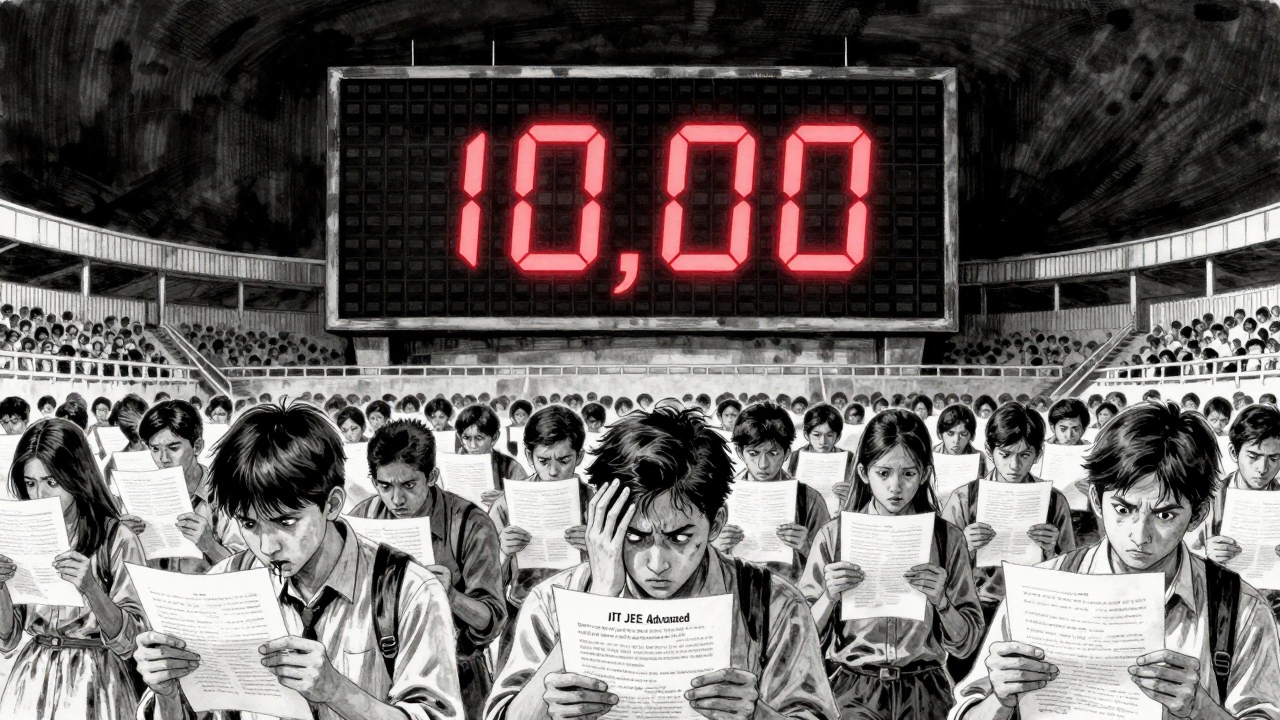
IIT JEE Advanced is even narrower. Around 2.5 lakh students qualify for the Advanced exam each year after clearing JEE Main. Only about 10,000 get into any of the 23 IITs. That’s a 4% success rate. But here’s the catch: the top 2,000 get into the most sought-after branches like Computer Science at IIT Bombay or Delhi. The rest fight for remaining seats in less popular colleges or branches. The syllabus covers physics, chemistry, and math at a level most engineering professors would find tough.
NEET, the medical entrance exam, is brutal in a different way. Over 22 lakh students appear for NEET every year. Only about 1.2 lakh get into MBBS seats across India. That’s a 5.5% success rate. But the real competition is for government medical colleges. In states like Tamil Nadu or Maharashtra, you need a score above 680 out of 720 to have a shot. In private colleges, fees can hit ₹1.5 crore for the entire course. So even if you clear NEET, you might not get a seat you can afford.
Global Contenders: GRE, GMAT, and the Gaokao
Outside India, the competition looks different but is just as intense.
The Gaokao, China’s national college entrance exam, is often called the world’s hardest. Over 12 million students take it every June. Their entire future-what university they attend, what career they can pursue-depends on this one test. Scores are ranked nationwide. The top 1% get into Tsinghua or Peking University. The rest are sorted into tiered institutions based on exact percentile. A single point can mean the difference between studying engineering in Beijing or working in a factory back home. The exam lasts two days. Students wake up at 4 a.m. to study. Some schools have anti-stress rooms with psychologists on standby.
The GRE and GMAT aren’t as massive in numbers, but they’re fiercely competitive in context. For top U.S. graduate programs, a GRE score above 330 (out of 340) is often required. Only 1% of test-takers hit that mark. For MBA programs at Stanford, Harvard, or Wharton, GMAT scores above 740 are the norm. Less than 10% of applicants get in. These exams aren’t about volume-they’re about elite filtering. You’re not just competing against peers. You’re competing against the best from India, China, Nigeria, Brazil, and beyond-all with perfect GPAs, internships, and recommendation letters.
Why Numbers Alone Don’t Tell the Whole Story
Comparing exams by raw selection rates can be misleading. UPSC has a lower selection rate than IIT JEE, but IIT JEE has higher stakes for families investing ₹5-10 lakh in coaching. NEET has more takers, but UPSC has more long-term societal impact.
Think of it this way: IIT JEE is like climbing Mount Kilimanjaro with a 10-hour time limit. NEET is like running a marathon with 2 million others and only 100 finishers get a free hospital bed. UPSC is like running that same marathon, then writing a 200-page policy paper, then surviving a 45-minute interrogation by retired bureaucrats-all while your parents are selling their land to pay for your coaching.
Also, competition isn’t just about who gets in. It’s about who gets left behind. In India, over 10 lakh IIT JEE aspirants drop out after failing twice. Many suffer depression. Some take their lives. The system doesn’t measure resilience-it measures scores.
The Hidden Cost of Competition
Behind every top exam is a hidden economy. Coaching centers in Kota, Delhi, and Hyderabad make over ₹20,000 crore a year. Online platforms like Unacademy and Byju’s spend billions on ads. Parents take second jobs. Siblings delay their education. Families live in rented rooms near coaching hubs.
In China, the Gaokao has led to a booming tutoring industry worth over $100 billion. In the U.S., SAT prep companies like Kaplan and Princeton Review charge up to $5,000 for a single course. The system isn’t just testing knowledge. It’s testing financial access.
And then there’s the mental toll. A 2024 study by the Indian Psychiatric Society found that 42% of UPSC aspirants showed signs of clinical anxiety. Among IIT JEE repeaters, that number jumped to 58%. The exams don’t just select talent-they filter out mental health.
So, Which Exam Is Most Competitive?
If you measure by selection rate alone, UPSC Civil Services is the toughest. Only 0.07% make it. But if you measure by societal pressure, financial cost, and psychological toll, IIT JEE and NEET are just as brutal. If you look globally, the Gaokao is the most high-stakes exam in terms of national impact.
There’s no single winner. The most competitive exam is the one you’re sitting for. Because for the student who’s studying 16 hours a day, skipping birthdays, and living on instant noodles-it doesn’t matter what the statistics say. Their exam is the hardest one in the world.

What Makes an Exam Truly Competitive?
It’s not just about the numbers. Here’s what turns a tough exam into a legendary one:
- High volume: More than 1 million applicants
- Low selection rate: Under 5%
- High stakes: Determines career, income, social status
- Long preparation: 1-3 years of full-time study
- Financial burden: Families spend more than annual income
- Social pressure: Community expectations, family honor
- Mental health cost: High rates of anxiety, depression, suicide
Exams that hit 5 or more of these are in the top tier. UPSC, IIT JEE, NEET, and Gaokao hit all seven.
Is There a Way Out?
Some students are starting to question the system. More are choosing alternative paths: coding bootcamps, online certifications, entrepreneurship, or studying abroad where admission is more holistic. In 2025, over 1.2 lakh Indian students applied to universities in Germany and Canada that don’t require entrance exams-only portfolios, essays, and interviews.
But for now, the old exams still rule. They’re the gatekeepers of prestige, power, and security. And until the system changes, they’ll keep being the most competitive exams on the planet.
Is UPSC the most competitive exam in the world?
UPSC has one of the lowest selection rates globally-just 0.07%-making it the most selective in terms of raw numbers. But competitiveness isn’t only about acceptance rate. Exams like China’s Gaokao involve higher societal pressure, and IIT JEE demands extreme academic rigor. UPSC is the most competitive if you’re measuring how few people succeed out of millions who try.
How does IIT JEE compare to the SAT?
IIT JEE is far more difficult than the SAT. The SAT tests basic math, reading, and writing skills. IIT JEE Advanced covers advanced calculus, organic chemistry, and complex physics problems at a university freshman level. Only 4% of IIT JEE qualifiers get into an IIT, while over 80% of SAT takers get into a U.S. college. The SAT is a gatekeeper; IIT JEE is a gauntlet.
Why is NEET so difficult to crack?
NEET is difficult because there are too many candidates and too few government medical seats. Over 22 lakh students compete for just 1.2 lakh MBBS seats. To get into a top government college, you need to score above 680 out of 720. The competition isn’t just about knowledge-it’s about precision. One wrong answer can drop you 100 ranks. And private colleges charge up to ₹1.5 crore, making affordability part of the battle.
Is the Gaokao harder than UPSC?
The Gaokao is harder in terms of scale and stakes. Over 12 million students take it, and their entire future depends on one 2-day exam. UPSC is harder in terms of preparation depth and duration-it takes years of studying law, economics, history, and ethics. But Gaokao scores determine whether you attend Tsinghua or work in a factory. UPSC selects bureaucrats; Gaokao selects the entire next generation.
Can you prepare for these exams without coaching?
Yes, but it’s rare. Around 8-10% of UPSC toppers and 5% of IIT JEE rankers are self-prepared. They use free online resources like NPTEL, YouTube channels like Unacademy Free, and old question papers. But coaching centers provide structure, peer pressure, and test patterns that are hard to replicate alone. Without coaching, you need extreme discipline, access to quality study material, and a support system.