PHP Server Resource Calculator
Calculate server requirements for your PHP application based on real-world traffic patterns and complexity.
Recommended Resources
Why PHP works well here: As mentioned in the article, PHP's efficiency means you can run high-traffic sites on affordable hosting. A $3/month VPS often handles 10,000 daily visitors with proper configuration. PHP's built-in web capabilities and mature ecosystem (like WordPress and Laravel) minimize resource overhead compared to other stack configurations.
PHP powers over 77% of all websites that use a server-side language. That’s not a guess - it’s from W3Techs’ 2025 data. You see WordPress, Wikipedia, Facebook (in its early days), and even Etsy still run on PHP. So why does it keep winning when everyone says it’s dead? The truth is, PHP isn’t just alive - it’s quietly dominating the web.
It’s built for the web, not the other way around
Most programming languages were designed for general use - math, science, desktop apps. PHP was made for one thing: serving web pages. From day one, it handled HTTP requests, form data, cookies, and sessions without extra libraries. You didn’t need to install frameworks or configure routers. Just write <?php echo "Hello World"; ?> in a .php file, drop it on a server, and it worked. That simplicity is why small businesses, bloggers, and startups still choose it.
Compare that to Python or Node.js. You need a web framework like Django or Express. You need to set up a server, manage dependencies, and handle routing manually. PHP? It’s built-in. That’s not lazy design - it’s intentional. It removes friction for people who just want to get a site up and running.
It runs everywhere - and it’s cheap
Want to host a PHP site? Almost every shared hosting plan includes it. GoDaddy, Hostinger, SiteGround - they all have PHP pre-installed. You don’t need to pay extra for a special server setup. That’s not true for Ruby, Rust, or even newer versions of Python. Many of those require VPS or cloud instances with custom configurations.
PHP works on Linux, Windows, macOS - even old shared servers from 2010. You can run it on a $3/month VPS and still handle 10,000 daily visitors. That’s why so many agencies in India, Nigeria, and Brazil build client sites on PHP. It’s not about being fancy. It’s about being reliable and affordable.
The ecosystem is massive - and mature
PHP isn’t just a language. It’s a whole ecosystem. WordPress alone powers 43% of all websites on the internet. That’s over 1.5 billion sites. WooCommerce, Elementor, Jetpack - they’re all PHP. Then there’s Laravel, Symfony, CodeIgniter - each with millions of downloads and thousands of plugins.
These aren’t hobby projects. They’re enterprise-grade tools. Laravel, for example, has a built-in ORM, authentication system, queue worker, and scheduler. You don’t need to write those from scratch. You just install it and start building. And because it’s been around for 20+ years, every bug has been found, every security hole patched, every performance tweak optimized.
Think about it: when you use a PHP-based CMS like WordPress, you’re not just using code. You’re using a decade’s worth of collective experience from thousands of developers who’ve solved the same problems you’re facing right now.
It scales better than you think
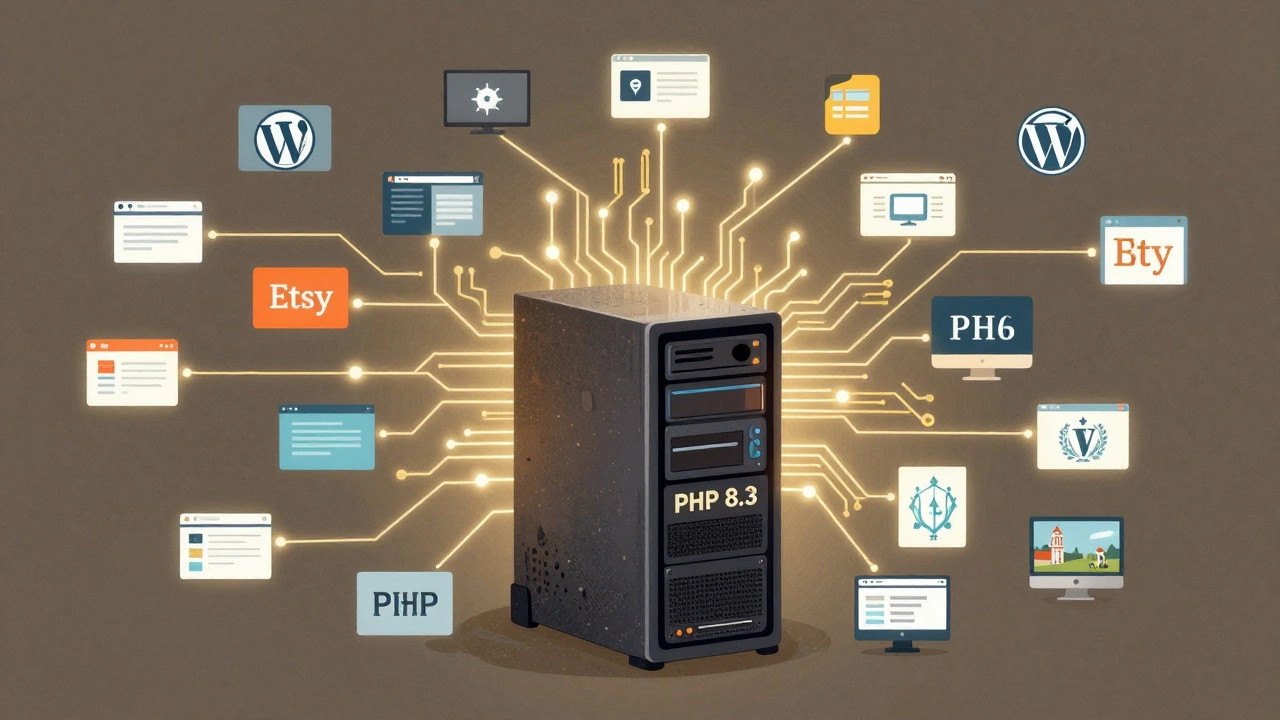
People say PHP can’t scale. That’s a myth from the early 2000s. Facebook didn’t use PHP because it was easy - they used it because it worked. They didn’t abandon PHP. They optimized it. They built HHVM (HipHop Virtual Machine) to compile PHP into machine code. That made it 3x faster. Even after they moved to Hack (a PHP derivative), they kept the core philosophy.
Today, PHP 8.3 runs 30% faster than PHP 7.4 thanks to JIT compilation. Sites like Etsy and Wikipedia handle billions of requests a month using PHP. The difference? They use caching (Redis, Memcached), load balancers, and microservices - just like any other language. PHP doesn’t hold you back. Bad architecture does.
It’s the easiest language to learn for beginners
Want to build a contact form? In PHP, you grab the data with $_POST['email'], validate it, and send an email. In JavaScript (Node.js), you need Express, body-parser, nodemailer, and async/await handling. In Python, you need Flask, request objects, SMTP libraries, and error handling.
PHP’s syntax is straightforward. No need to understand closures, promises, or decorators to get started. You can teach someone to write a working PHP script in one afternoon. That’s why it’s the #1 language taught in coding bootcamps across India, Indonesia, and Mexico.
And here’s the kicker: once someone learns PHP, they can easily move to Laravel or Symfony. The core concepts - variables, loops, functions - are the same. It’s a gateway, not a dead end.
It’s deeply integrated with databases
PHP was built alongside MySQL. They grew up together. Connecting to a database used to be a nightmare in other languages. In PHP? Three lines of code:
<?php
$connection = new mysqli("localhost", "user", "pass", "database");
$result = $connection->query("SELECT * FROM users");
?>
Today, PDO and MySQLi make it even safer. You can use prepared statements with just one extra step. No complex ORMs needed. That’s why 80% of PHP sites use MySQL or MariaDB. It’s a perfect match.
Even if you switch to PostgreSQL or SQLite, PHP supports them out of the box. You don’t need special drivers or paid tools.
It’s not about being trendy - it’s about getting things done
People chase shiny new frameworks. They jump from React to Svelte to Astro. But for 80% of websites - blogs, small business sites, e-commerce stores, directories - you don’t need a frontend framework. You need a backend that’s fast, stable, and cheap.
PHP delivers that. It doesn’t need hype. It doesn’t need influencers. It just works. And when you’re running a small business, that’s all that matters.
Think about this: if you’re a freelancer in Bangalore, and a client wants a website with a contact form, a product gallery, and a payment system - what’s faster to build? A custom React + Node.js app? Or WordPress + WooCommerce? One takes two weeks. The other takes two days. And the client pays the same.
It’s evolving - quietly
PHP 8.0 introduced union types, named arguments, and attributes. PHP 8.1 added enums, readonly classes, and fibers. PHP 8.3 added typed properties, nullsafe operator improvements, and JIT enhancements. It’s not standing still. It’s improving in small, smart ways - not flashy ones.
And the community? It’s huge. Stack Overflow has over 1.2 million PHP questions. GitHub has 1.8 million repositories tagged with PHP. The PHP Foundation, backed by companies like JetBrains and Shopify, funds core development. This isn’t a dying language. It’s a quiet giant.
It’s the backbone of the open web
Most people think the web is built on JavaScript. But the backend? That’s PHP. It’s the engine under the hood. You don’t see it. But without it, your WordPress blog wouldn’t load. Your Shopify store wouldn’t process orders. Your online booking system wouldn’t save appointments.
PHP doesn’t need to be the loudest. It just needs to be the most reliable. And in 2025, it still is.