Free Coding Roadmap Generator
Not sure where to start? Answer these three questions to get a tailored study plan using the best free resources available.
Your Personalized Plan
Target Timeline
Based on consistent practice and project completion.Primary Language
Step-by-Step Curriculum
💡 Pro Tip
You want to learn how to code. You open your browser, type in "learn coding," and immediately hit a wall of $15,000 bootcamp ads and confusing jargon about "full-stack development." It’s overwhelming. But here is the truth that tech recruiters know but rarely say out loud: you do not need to spend a dime to learn the fundamentals of programming. In fact, some of the best developers in Silicon Valley started with nothing but a laptop, Wi-Fi, and free internet resources.
The question isn't just "can" you learn coding online for free; it's whether you have the discipline to stick with it when there is no instructor breathing down your neck. The landscape of free coding education is a vast ecosystem of platforms offering zero-cost access to programming knowledge has exploded since 2020. With high-quality content available from top universities and industry leaders, the barrier to entry is now purely motivational, not financial.
The Reality of Free vs. Paid Education
Before we dive into the specific websites, let's clear up a misconception. Free doesn't mean low quality. Some of the most rigorous computer science curricula are available at no cost. However, free learning comes with trade-offs. You lose the structured accountability of a paid bootcamp. You don't get a dedicated career coach or guaranteed job placement services. You are on your own to build a portfolio that proves your skills to employers.
If you are self-motivated, curious, and willing to troubleshoot errors late at night without immediate help, free resources are more than enough to land an entry-level role. If you need hand-holding and strict deadlines, you might eventually pay for structure. But for most beginners, starting for free is the smartest move. It lets you test if you actually enjoy coding before investing thousands of dollars.
Top Platforms for Learning to Code for Free
Not all free resources are created equal. Some are outdated, while others are actively maintained by industry giants. Here are the best places to start your journey in 2026, categorized by what they offer.
| Platform | Best For | Key Languages | Certificate? |
|---|---|---|---|
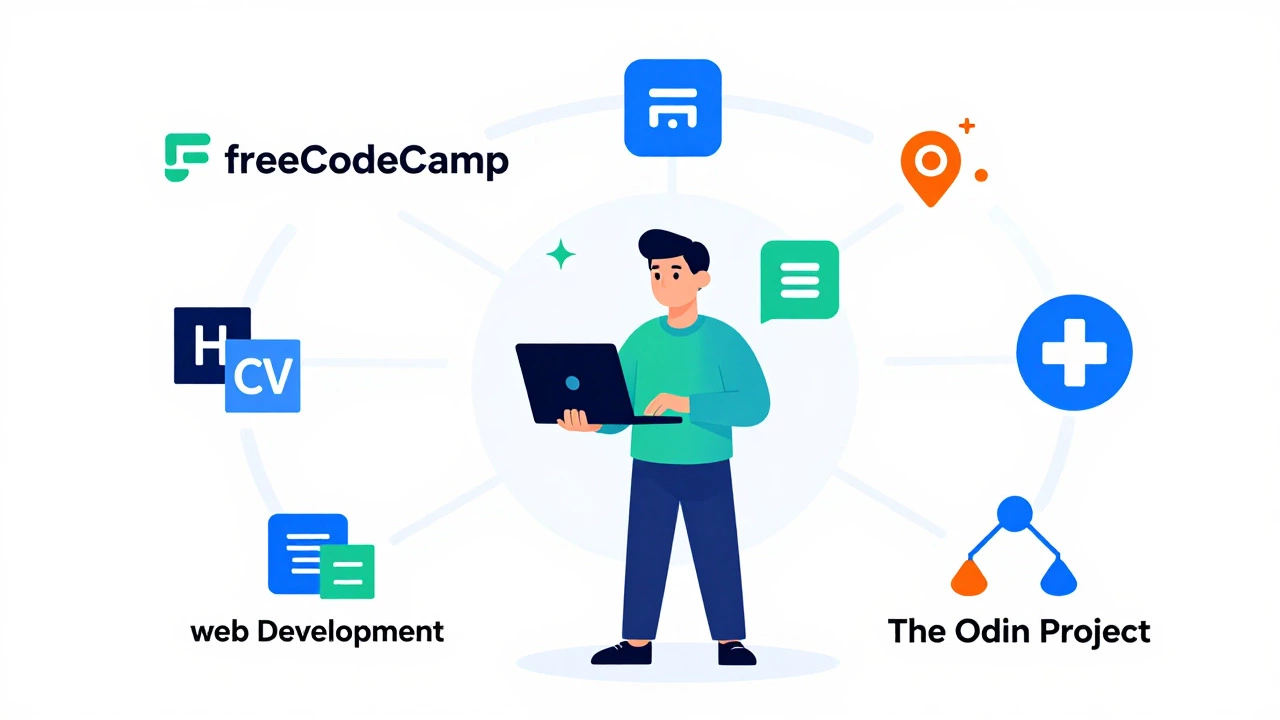
| freeCodeCamp | Web Development & Projects | HTML, CSS, JavaScript, Python | Yes (Free) |
| Harvard CS50 | Computer Science Fundamentals | C, Python, SQL, Java | Optional (Paid) |
| The Odin Project | Full-Stack Web Dev | Ruby, JavaScript, React | No |
| Khan Academy | Visual Learners & Basics | JavaScript, SQL | No |
| MIT OpenCourseWare | Academic Depth | Python, Java, C++ | No |
freeCodeCamp: The Project-Based Powerhouse
If you only pick one resource, make it freeCodeCamp is a non-profit organization providing interactive coding curriculum focused on web development and data science. Unlike video-heavy courses, freeCodeCamp forces you to write code immediately. You solve small challenges to unlock the next lesson. This active recall method is scientifically proven to be better for retention than passive watching.
Their certification path covers everything from responsive web design to back-end development with Node.js and Express. By the time you finish their main curriculum, you will have built five major projects for each certification. These projects become the core of your portfolio. Employers care less about certificates and more about seeing code you wrote. freeCodeCamp gives you both.
Harvard CS50: The Gold Standard of Introductory CS
David Malan’s introduction to computer science at Harvard University is legendary. Even though it’s a university course, the entire content is free on edX and YouTube. CS50 teaches you how computers think. It starts with C, a low-level language that makes you understand memory management and pointers, before moving to Python, SQL, and HTML/CSS.
This course is tough. It is designed to filter out those who aren’t serious. But if you push through the problem sets (called "psets"), you will have a foundational understanding that many bootcamp graduates lack. You won’t just know how to use a framework; you’ll understand why it works the way it does. This depth makes you a stronger engineer in the long run.
The Odin Project: Building Real Developer Environments
Most beginners struggle because they code in a browser-based editor that hides the messy reality of development. The Odin Project is an open-source full-stack curriculum that teaches students to set up local development environments. It forces you to install tools like Git, GitHub, and command-line interfaces on your actual computer.
This is crucial. When you apply for jobs, you won’t be coding in a simplified sandbox. You’ll be working in complex terminal environments. The Odin Project prepares you for this by making you read documentation, debug configuration issues, and collaborate using version control. It feels harder at first, but it mimics the real job experience closely.
Choosing Your First Language: A Strategic Decision
New learners often ask, "Which language should I learn first?" The answer depends on your goals. There is no single "best" language, but there are strategic choices based on market demand and learning curve.
- JavaScript: Essential for web development. If you want to build websites, apps, or see visual results quickly, start here. It runs in every browser, so you don’t need to install anything to begin.
- Python: Ideal for data science, artificial intelligence, and backend automation. Its syntax reads like English, making it very beginner-friendly. It is also highly versatile outside of pure software engineering.
- HTML/CSS: Not technically programming languages, but markup and style sheets. They are the building blocks of the web. Every web developer must know these, regardless of their primary language.
- Java or C#: Better for enterprise applications, Android development, or game development (Unity). These are stricter languages that teach good object-oriented habits early on.
For most people seeking a career change in 2026, JavaScript or Python offers the fastest route to employability. JavaScript allows you to work on both the front-end (what users see) and back-end (server logic), making you a "full-stack" candidate sooner.
The Hidden Curriculum: Soft Skills and Community
Coding is not just about typing syntax. It is about solving problems. Free online learning isolates you, which can lead to burnout. To counter this, you must actively seek community.
Join Discord servers related to the technologies you are learning. Participate in forums like Stack Overflow (but read the rules before posting!). Contribute to open-source projects on GitHub. These actions signal to future employers that you can communicate technical ideas and work with others. Many senior developers mentor juniors for free on platforms like ADPList. Finding a mentor can accelerate your learning curve significantly.
Also, learn to read documentation. Tutorials expire. Documentation lasts. The ability to navigate official docs for React, Django, or Vue.js is a superpower. Free resources teach you this skill naturally because you have to dig deeper to find answers when things break.
Building a Portfolio Without Spending Money
Your degree or certificate is secondary to your portfolio. Since you are learning for free, you need to prove your skills through tangible work. Here is how to build a professional portfolio using free tools:
- GitHub: Host all your code here. Write clean README files explaining what each project does, how to run it, and what technologies were used. Treat your GitHub profile like your resume.
- Netlify or Vercel: Deploy your web projects for free. Give them custom domains if possible (you can buy a domain for ~$10/year, which is a worthwhile investment). Having a live link beats a static screenshot every time.
- Personal Website: Build a simple site showcasing your bio, contact info, and links to your projects. Use this as a central hub for recruiters.
- Blogging: Start writing about what you learn. Explaining concepts publicly reinforces your own understanding and builds personal brand authority. Medium and Dev.to are great free platforms for this.
Focus on quality over quantity. Three well-documented, functional projects are better than ten half-finished tutorials. Solve real problems. Did you automate a boring task at your current job? Build a budget tracker? Create a weather app that alerts you for rain? These show initiative and practical application.
Pitfalls to Avoid When Learning for Free
Even with the best resources, many beginners quit. Why? Usually because they fall into common traps.
Tutorial Hell: This happens when you watch endless videos but never code independently. You feel productive, but you’re just copying. Break the cycle by pausing the tutorial and trying to build something slightly different on your own. Struggle is where learning happens.
Jumping Between Resources: Don’t switch from freeCodeCamp to Udemy to Coursera every week. Pick one comprehensive curriculum and stick with it until you complete it. Consistency beats intensity. Coding for 30 minutes every day is far more effective than binge-coding for 10 hours on Sunday.
Ignoring Fundamentals: Frameworks like React or Angular change frequently. Core concepts like variables, loops, functions, and data structures remain constant. Spend extra time mastering these basics. They transfer across languages and technologies.
Next Steps: From Beginner to Job Ready
Learning to code for free is entirely possible, but it requires a shift in mindset. You are not a student waiting to be taught; you are a practitioner building skills. Start today. Pick one platform from the list above. Commit to 30 minutes a day. Join a community. Build something broken, fix it, and build again.
The tech industry values competence over credentials. If you can demonstrate that you can build, debug, and deploy software, your background matters less. The door is open. All you have to do is walk through it.
Is it really possible to get a job as a developer with only free certifications?
Yes, absolutely. Tech companies care more about your ability to solve problems and your portfolio than the price tag of your education. Many successful developers are self-taught using free resources. Focus on building a strong GitHub portfolio and contributing to open source to validate your skills.
How long does it take to learn coding for free?
It varies based on your dedication, but typically 6 to 12 months of consistent study (10-15 hours per week) can bring you to a junior developer level. Mastery takes years, but employable skills can be acquired in under a year if you focus on practical projects rather than just theory.
Do I need a computer science degree to succeed?
No. While a CS degree provides deep theoretical knowledge, it is not required for most web development and software engineering roles. Free courses like Harvard's CS50 provide similar foundational knowledge. Employers prioritize practical coding skills and problem-solving abilities.
Which is better: freeCodeCamp or The Odin Project?
Both are excellent but serve different styles. freeCodeCamp is better for interactive, bite-sized learning with immediate feedback. The Odin Project is better for those who want to set up a professional local development environment and tackle larger, more complex projects early on. Try both for a week and see which fits your learning style.
Are free coding certificates worth adding to my resume?
They are worth mentioning, especially if you are a career changer with no prior tech experience. They show initiative and commitment. However, ensure your portfolio projects are highlighted more prominently. Certificates prove you learned the material; projects prove you can apply it.
Can I learn AI and Machine Learning for free?
Yes. Once you have a foundation in Python, you can explore free courses from Andrew Ng on Coursera (audit mode), fast.ai, and Google’s Machine Learning Crash Course. These resources provide high-quality instruction on algorithms, neural networks, and data processing without cost.