JEE Advanced Self-Study Readiness & Planner
Readiness Checklist
Check the traits you currently possess to see if you're equipped for the solo path.
Daily Block Planner
Allocate your hours to create a balanced Advanced-focused routine.
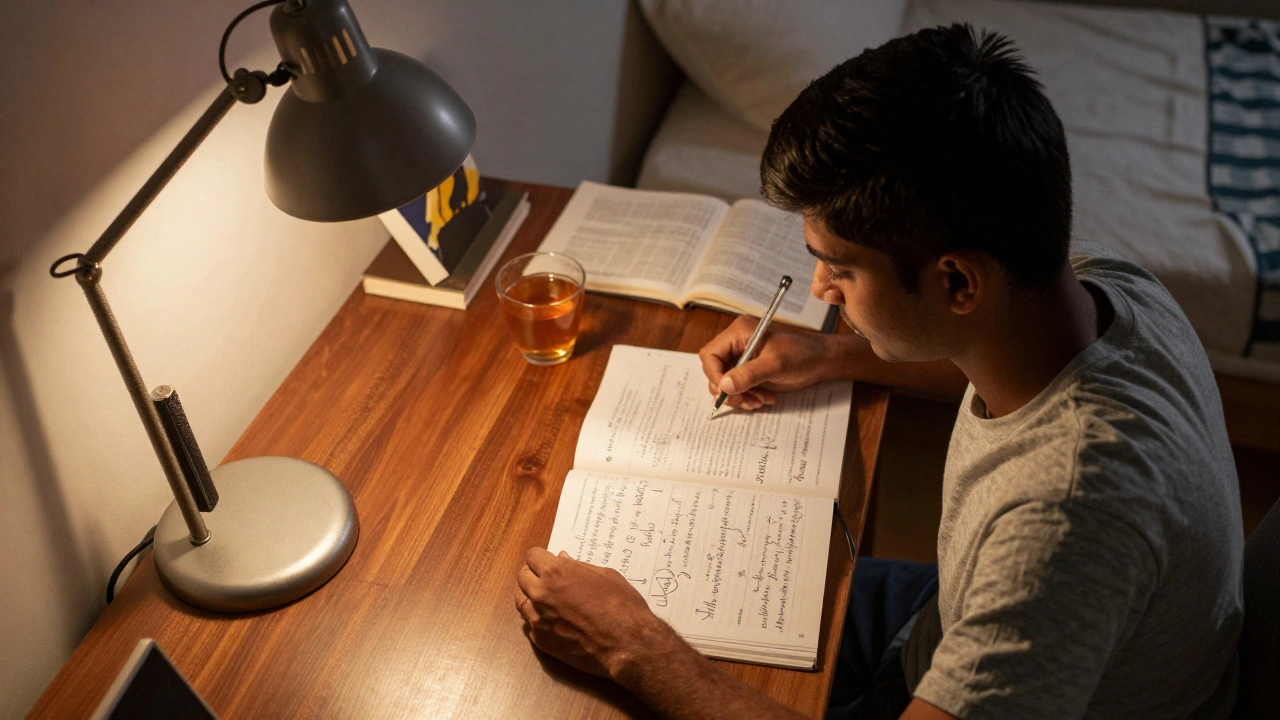
The myth that you need a massive coaching center in Kota or Hyderabad to get into an IIT is one of the most stressful narratives in the Indian education system. Every year, thousands of students believe that without a high-priced classroom and a set of pre-printed modules, the gates of the Indian Institute of Technology are closed to them. But here is the truth: yes, people crack it through self-study. It is rare, but it happens. The real question isn't whether it's possible, but whether you have the specific kind of discipline and the right tools to pull it off without a teacher hovering over your shoulder.
Key Takeaways for Self-Studiers
- Self-study is viable if you have a strong grasp of basics and extreme self-discipline.
- Standard textbooks (NCERT and reference books) are more important than coaching modules.
- Consistent mock testing is the only way to gauge progress without a mentor.
- Digital resources like NPTEL and YouTube have democratized high-level physics and math.
The Reality of the Self-Study Path
Let's be honest-going solo is the hard way. When you're in a coaching institute, you have a curated path. Someone tells you what to read on Monday and what to solve on Tuesday. When you choose JEE Advanced self study, you are the student, the teacher, and the administrator all at once. You have to build your own roadmap.
The JEE Advanced is not a test of how many formulas you've memorized; it's a test of how you apply concepts to unfamiliar problems. This is where most self-studiers struggle. Without a coach to point out "the trick" to a problem, you might spend five hours on a single physics question. While that's frustrating, it's actually where the real learning happens. The struggle is what builds the analytical muscles needed for the actual exam.
Building Your Own Resource Stack
You don't need secret modules. In fact, the "secret" modules used by top institutes are usually just curated problems from standard textbooks. To succeed alone, you need to own the gold-standard books that the toppers use. If you're missing these, you're fighting with one hand tied behind your back.
For Physics, H.C. Verma's Concepts of Physics is non-negotiable. It teaches you how to think, not just how to calculate. For Chemistry, the NCERT textbooks are essentially the Bible; almost every inorganic chemistry question in the exam can be traced back to those pages. For Mathematics, books by Cengage or Arihant provide the depth and variety of problems required to handle the complexity of the Advanced paper.
| Subject | Primary Resource | Advanced Resource | Focus Area |
|---|---|---|---|
| Physics | H.C. Verma | Irodov | Conceptual Clarity & Application |
| Chemistry | NCERT | OP Tandon / MS Chauhan | Reaction Mechanisms & Trends |
| Mathematics | NCERT / RD Sharma | Cengage Series | Problem Solving Speed & Logic |

The "Job-to-be-Done": Managing Your Schedule
The biggest killer of self-study dreams is the "procrastination loop." Without a center to report to, it's easy to say, "I'll do Organic Chemistry tomorrow." To avoid this, you need a rigid system. Don't just make a timetable; make a contract with yourself.
A successful self-study routine usually splits the day into three blocks. The morning block (when the brain is freshest) should be reserved for the hardest subject-usually Math for most, or Physics for others. The afternoon is for Chemistry, which requires a mix of memory and logic. The evening should be dedicated exclusively to solving Previous Year Questions (PYQs). If you aren't solving at least 20-30 high-quality problems a day, you aren't preparing for Advanced; you're just reading a book.
Overcoming the "Mental Wall"
There will be a moment-usually around the sixth month-where you hit a wall. You'll solve a mock test, score terribly, and think, "Maybe I really do need a coach." This is the danger zone. In a coaching center, your peer group keeps you going. Alone, the silence can be deafening.
To fight this, leverage the digital community. Use platforms like Reddit or specialized Discord servers to discuss doubts. If a concept in Electromagnetism isn't clicking, don't spend three days staring at the same page. Search for a visualization on YouTube or a lecture from NPTEL. The goal is to move past the block quickly so you can get back to solving.
The Mock Test Strategy
You cannot crack JEE Advanced without simulating the exam environment. The exam is as much a test of endurance as it is of knowledge. Sitting for six hours in a high-pressure environment is an athletic feat for the mind.
- The Simulation: Set a timer for exactly 3 hours for each paper. No phone, no water breaks except during the allotted time, and no music.
- The Analysis: This is where 90% of students fail. Don't just check the answer key. Spend four hours analyzing a three-hour test. Why did you miss that question? Was it a conceptual gap, a silly calculation error, or a time-management failure?
- The Iteration: If you consistently fail in "Coordinate Geometry," don't just resolve the problem-go back to the theory and relearn the entire chapter.

Common Pitfalls to Avoid
One mistake many self-studiers make is "Resource Hoarding." They download 50 PDFs, buy five different book series, and follow ten different YouTube channels. This leads to analysis paralysis. Pick one primary book and one secondary resource per subject. Depth beats breadth every single time in the Advanced paper.
Another trap is ignoring the JEE Main preparation. Remember, you can't sit for Advanced unless you clear Main. Some students dive so deep into advanced problems that they forget the basic, fast-paced nature of the Main exam. Keep a balance: 70% Advanced focus, 30% Main speed-drills.
Frequently Asked Questions
Is self-study enough to get a top 1000 rank?
Yes, it is possible, but it requires a higher level of maturity. Top ranks are usually achieved by those who can identify their own weaknesses and fix them without being told. If you can analyze your mock tests honestly and have the grit to solve 100+ problems a day, your rank depends on your effort, not your coaching.
How do I handle doubts without a teacher?
Use a combination of tools. First, try to solve the problem again after a 24-hour break. If you're still stuck, check the solution manual to understand the logic, not just the answer. For conceptual doubts, YouTube channels dedicated to JEE or forums like StackExchange can be lifesavers. Many students also find a study buddy online to cross-verify answers.
Which is more important: Theory or Problems?
For JEE Advanced, they are inseparable. Theory without problems is useless, and problems without theory are just guesswork. The ideal ratio is 30% theory and 70% problem solving. You should read the theory just enough to start solving, and then use the problems to discover where your theoretical understanding is lacking.
Can I start self-study in Class 12?
It's a steep climb, but doable. You will need to dedicate significantly more hours per day to cover the Class 11 syllabus. Prioritize high-weightage chapters first (like Mechanics in Physics and Calculus in Math) to ensure you have a fighting chance at the cutoff before polishing the smaller topics.
Do I need to buy expensive test series?
You don't need the most expensive one, but you do need a reliable one. A good test series provides a ranking among thousands of students, which is the only way to know where you stand. Look for series that are known for having a difficulty level close to the actual JEE Advanced rather than those that are impossibly hard or too easy.
Next Steps for Your Journey
If you've decided to go the self-study route, your first step is a "Content Audit." List every chapter in the syllabus and mark them as Green (Confident), Yellow (Need Practice), or Red (Clueless). Start your day with a Yellow topic to build momentum, then tackle a Red topic, and finish with a Green one to keep your confidence high.
Remember, the path of the self-studier is lonely, but it's also the most rewarding. When you finally solve a complex problem on your own, you aren't just learning physics or math-you're learning how to learn. That skill will serve you far better inside the walls of an IIT than any coaching module ever could.