
English Fluency Timeline Estimator
Stop guessing and start planning. Use this tool to estimate your realistic path to conversational confidence or professional mastery.
Your Estimated Path
Enter your details above to get personalized advice.
You’ve probably heard the myth that you can become fluent in English in just three months. Or maybe you’re stuck in a loop of studying grammar for years without ever feeling confident enough to order coffee in London. The truth is messier and more hopeful than either extreme. There isn’t one magic number, but there is a predictable pattern based on science and thousands of learner success stories.
So, how many days will it take to speak English fluently? For most people starting from zero, reaching conversational comfort takes about 600 to 750 hours of active study. If you treat it like a part-time job-two hours a day-that’s roughly 10 to 12 months. But if you immerse yourself fully, you could cut that down to four or five months. The variable isn’t just time; it’s intensity and method.
The Science Behind Your Learning Speed
To understand the timeline, you have to look at what "fluency" actually means. Most institutions use the Common European Framework of Reference for Languages (CEFR), which breaks language ability into six levels: A1 through C2. When people ask about fluency, they usually mean B2 (Upper Intermediate) or C1 (Advanced). B2 is where you can handle complex texts and interact with native speakers without strain. C1 is near-native precision.
The Foreign Service Institute (FSI), which trains US diplomats, estimates that English speakers need around 600-750 class hours to reach professional proficiency in languages similar to English (like Spanish or French). However, for non-native speakers learning English, the difficulty depends heavily on your native language. If you speak Hindi or Mandarin, the jump to English syntax and phonetics is larger, potentially adding 20-30% more time compared to someone who speaks German or Dutch.
| CEFR Level | Description | Hours Needed (from Zero) | Realistic Timeline (1 hr/day) |
|---|---|---|---|
| A1/A2 | Basic Survival | 180-350 hours | 6-12 months |
| B1 | Intermediate Threshold | 350-400 hours | 1 year |
| B2 | Fluent Conversation | 500-600 hours | 1.5 years |
| C1/C2 | Near-Native Mastery | 700+ hours | 2+ years |
Why Passive Listening Isn't Enough
Here is the biggest mistake learners make: confusing exposure with acquisition. You might listen to English podcasts while commuting, but unless you are actively processing the language, your brain treats it as background noise. To speed up the clock, you need Active Recall. This means forcing your brain to retrieve words and structures rather than just recognizing them.
Think of your vocabulary like a muscle. Reading builds the potential strength, but speaking exercises it. If you spend 80% of your time reading and only 20% speaking, your progress toward oral fluency will crawl. Flip that ratio once you hit the B1 level. Start talking to yourself, record voice notes, or join online conversation clubs. The discomfort of making mistakes is actually the signal that your brain is rewiring itself.
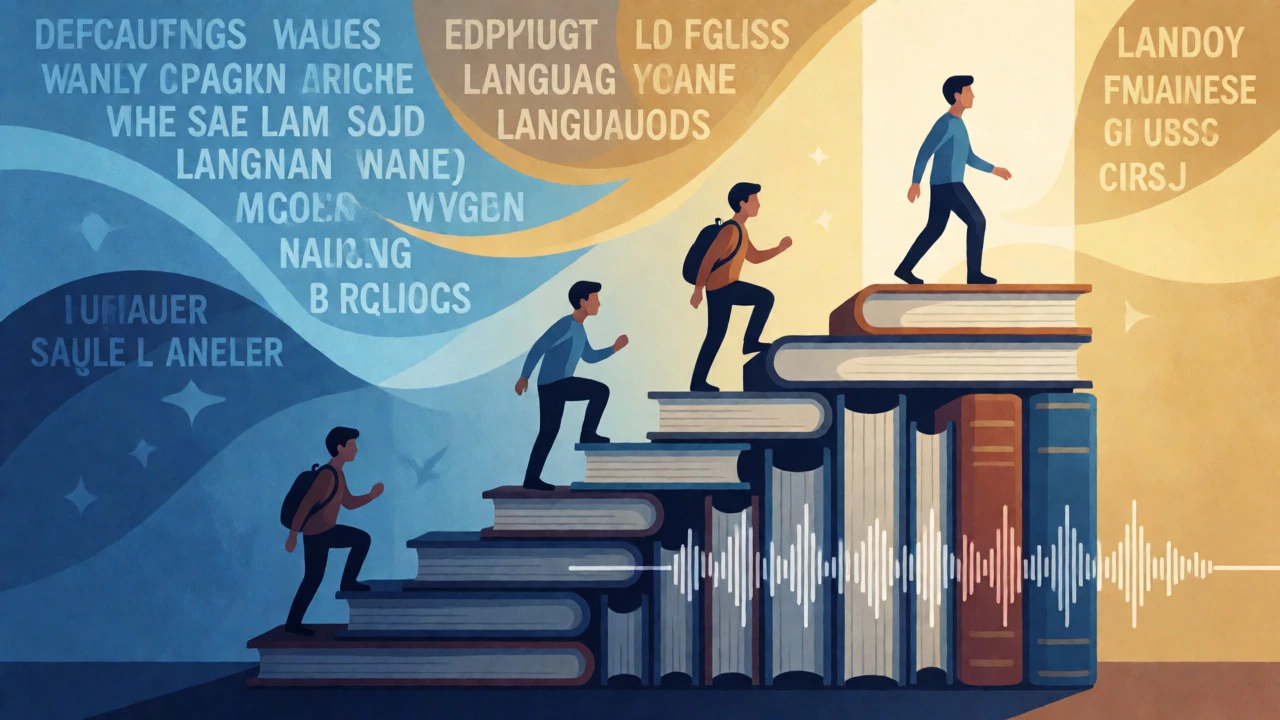
Factors That Accelerate or Slow You Down
Your environment plays a massive role. Living in an English-speaking country accelerates learning because necessity drives retention. You have to understand the bus driver or the doctor. But living abroad doesn’t guarantee fluency if you stay in an expat bubble. Conversely, you can achieve high fluency in India, Brazil, or Japan if you curate your digital and social environments strictly in English.
Age also matters, though less than pop culture suggests. While children absorb accents effortlessly, adults often learn grammar rules faster due to existing cognitive frameworks. Adults struggle with pronunciation not because their brains are too old, but because they fear judgment. Removing that emotional barrier is key. If you are shy, start with low-stakes environments like anonymous chat rooms or AI conversation partners before tackling face-to-face interactions.
A Practical Roadmap to Fluency
If you want to minimize the days it takes, stop studying English and start using it. Here is a realistic breakdown of how to structure your journey:
- Months 1-3 (The Foundation): Focus on high-frequency vocabulary (the top 1,000 words cover 85% of daily speech). Use apps like Anki for spaced repetition. Learn basic sentence structures. Don’t worry about perfect grammar yet; focus on being understood.
- Months 4-6 (The Bridge): Start consuming native content. Watch YouTube videos with English subtitles. Begin shadowing techniques, where you repeat audio immediately after hearing it to mimic rhythm and intonation. Start speaking with tutors or peers twice a week.
- Months 7-12 (The Deep Dive): Shift to complex inputs. Read news articles, listen to debates, and engage in discussions about abstract topics. This is where you bridge the gap between textbook English and real-world slang and idioms.
- Month 12+ (Polishing): Refine your accent and expand your lexical range. Work on nuance, humor, and cultural context. At this stage, fluency becomes automatic, and you stop translating in your head.

Defining "Fluently": What Are You Actually Aiming For?
Before you set a deadline, define your target. Do you need English for travel, business negotiations, or academic research? Travel fluency (A2/B1) can be achieved in 3-4 months with intense focus. Business fluency (B2/C1) requires specialized vocabulary and formal tone mastery, pushing the timeline to 12-18 months. Academic fluency (C1/C2) demands precise writing and complex argumentation, often taking 2+ years.
Don’t let perfectionism paralyze you. Many learners wait until they feel "ready" to speak, but readiness is a myth. You are never fully ready. You just get better at handling uncertainty. Fluency isn’t about knowing every word; it’s about communicating effectively despite the gaps.
Troubleshooting Common Stalls
If you’ve been studying for a year and still feel stuck, check these common pitfalls:
- The Intermediate Plateau: Progress slows down because you no longer feel the rapid gains of beginner stages. Solution: Change your input sources. Switch from textbooks to authentic media like movies, podcasts, or books.
- Fear of Mistakes: Anxiety blocks output. Solution: Practice mindfulness or breathing techniques before speaking sessions. Remind yourself that errors are data, not failures.
- Lack of Consistency: Studying 5 hours on Sunday does nothing compared to 30 minutes daily. Solution: Habit stacking. Attach English practice to an existing habit, like listening to a podcast during your morning coffee.
Ultimately, the question isn’t just "how many days," but "how many meaningful interactions." Every conversation, every misunderstood joke, and every successfully negotiated deal brings you closer. Set a realistic goal, commit to daily action, and trust the process. The timeline varies, but the destination is guaranteed for those who keep showing up.
Can I learn English fluently in 3 months?
Reaching full fluency (C1/C2) in 3 months is extremely difficult for most people. However, you can reach functional conversational confidence (B1 level) in 3 months if you study intensively (4-6 hours daily) and immerse yourself completely. Expect to make frequent mistakes and rely on simple vocabulary during this phase.
Does my native language affect how fast I learn English?
Yes, significantly. Speakers of Germanic or Romance languages (like German, Spanish, or French) often learn faster because English shares many cognates and grammatical structures with them. Speakers of Asian or Slavic languages may need more time to adjust to English syntax, articles, and phonetics, potentially extending the timeline by 20-30%.
Is watching Netflix enough to become fluent?
No, passive watching alone is rarely sufficient for fluency. While it helps with listening comprehension and cultural context, it lacks the active production required for speaking. To gain fluency, you must combine watching with active practice, such as repeating phrases, summarizing plots aloud, or discussing what you watched with others.
How important is grammar for speaking fluently?
Grammar is important for clarity, but over-focusing on it can hinder fluency. In early stages, prioritize communication over correctness. Native speakers often break grammar rules in casual speech. Aim for understandable sentences first, then refine accuracy as your confidence grows. Perfect grammar comes with extensive exposure and practice, not just rule memorization.
What is the fastest way to improve speaking skills?
The fastest method is active output combined with immediate feedback. Techniques include shadowing (mimicking native audio), recording yourself and reviewing it, and engaging in real-time conversations with tutors or language exchange partners. These methods force your brain to construct sentences quickly, bridging the gap between passive knowledge and active use.