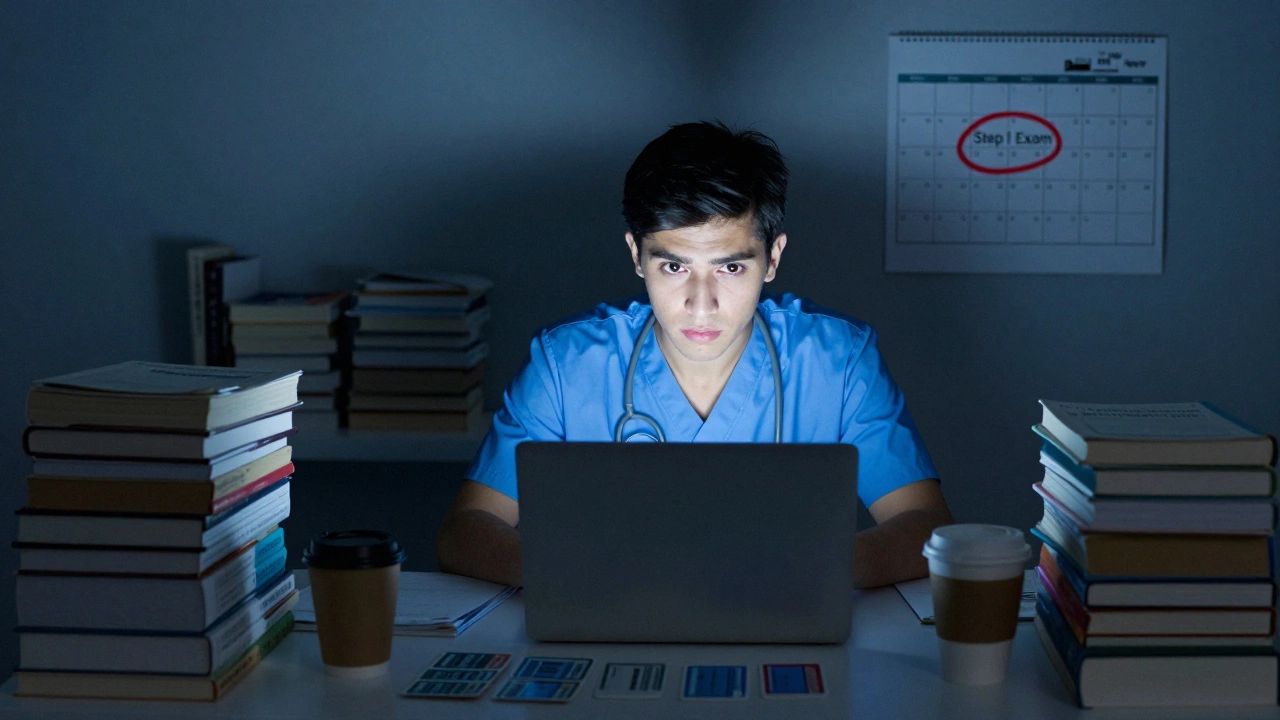
USMLE Preparation Cost & Time Calculator
Estimate Your USMLE Preparation Costs
Estimated Results
$1,015
$0-$500
$1,015 - $1,515
6 months
Key Insight: For international medical graduates (IMGs), the average total investment is $4,000-$6,000 and 8-12 months of preparation. Your estimated costs are within range of typical IMG requirements.
How This Compares to Other Exams
PLAB (UK)
Cost: £4,000-£5,000
Time: 3-6 months
MCCQE (Canada)
Cost: CAD $2,500-3,500
Time: 4-8 months
AMC (Australia)
Cost: AUD $2,000-3,000
Time: 6-12 months
If you're aiming to practice medicine in a major English-speaking country, you've probably heard whispers about the USMLE-the United States Medical Licensing Examination. It’s not just tough; it’s the most grueling medical licensing exam in the world, by nearly every metric that matters: pass rates, cost, length, pressure, and the sheer volume of knowledge it demands.
Why the USMLE Stands Out
The USMLE isn’t one test-it’s a three-step gauntlet. Step 1 tests foundational science knowledge, Step 2 CK (Clinical Knowledge) tests how well you apply that knowledge to patient care, and Step 3 tests whether you can manage patients independently. Each step is a full day of testing, with hundreds of multiple-choice questions and clinical case simulations. Step 1 alone has over 280 questions, and you have seven hours to finish it. No breaks between blocks. No skipping around. You’re locked in.
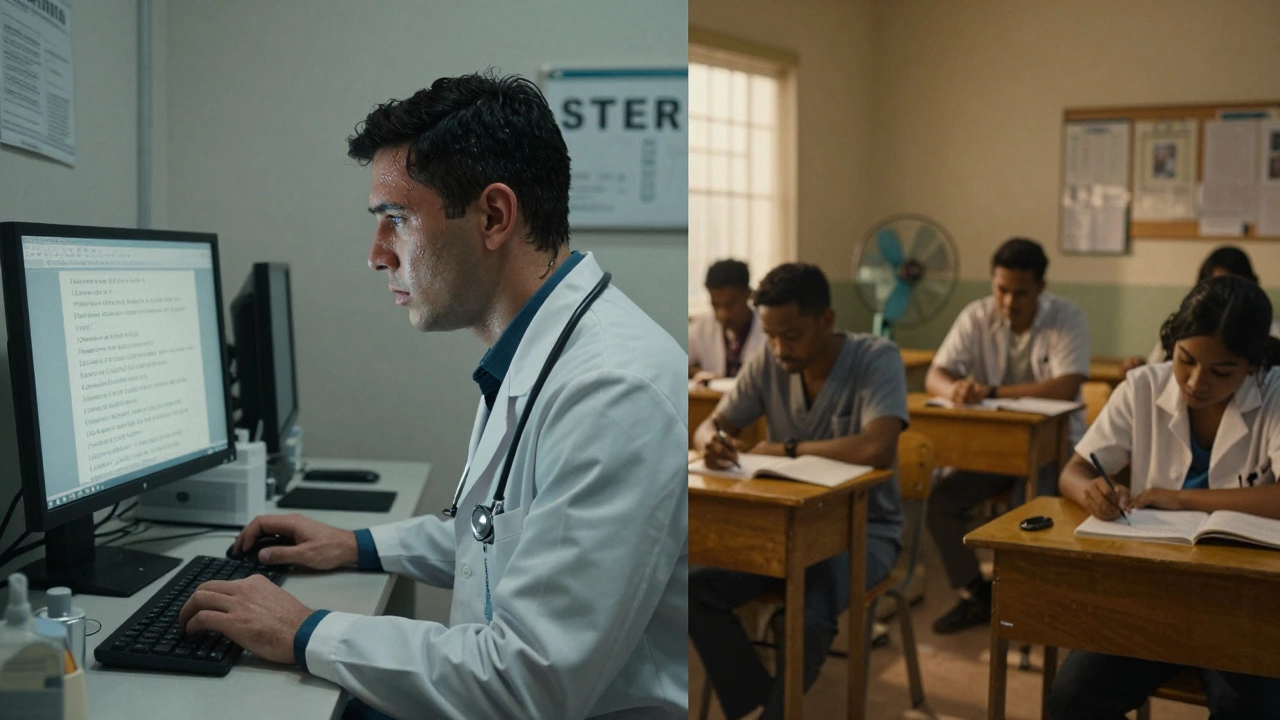
Pass rates tell the story. For U.S. medical graduates, the pass rate for Step 1 is around 94%. Sounds high, right? But for international medical graduates (IMGs), it’s closer to 70%. That 24-point gap isn’t about intelligence-it’s about preparation, resources, and the sheer scale of what’s expected. IMGs often study for 6-12 months full-time, spending $3,000-$6,000 just on exam fees and review materials. Many work part-time jobs while studying, sleep four hours a night, and still fail.
How It Compares to Other Major Exams
Let’s put it in context. The UK’s PLAB (Professional and Linguistic Assessments Board) is a two-part exam. Part 1 is multiple choice; Part 2 is an OSCE (Objective Structured Clinical Examination) with 14 stations. It’s challenging, yes-but it’s designed for doctors who already have a medical degree from abroad. The content scope is narrower, and the pass rate hovers around 75-80%.
Canada’s MCCQE (Medical Council of Canada Qualifying Examination) is also tough. Part I is a written exam with 180-210 questions, and Part II is an OSCE with 12-15 clinical stations. But unlike the USMLE, the MCCQE doesn’t require memorizing every detail of pharmacology or pathology. It focuses more on Canadian guidelines, ethical frameworks, and practical decision-making. The pass rate for Canadian graduates is over 90%; for IMGs, it’s about 78%.
Australia’s AMC (Australian Medical Council) exam has two parts: a multiple-choice test and a clinical exam. The pass rate for IMGs is around 60-65%. That’s lower than the USMLE for IMGs, but the AMC doesn’t have the same global reputation for intensity. Why? Because the USMLE is the gatekeeper to the largest, most lucrative medical job market in the world.
The Hidden Costs Beyond the Test
It’s not just the exam itself. The USMLE forces you to relocate. Most candidates take Step 1 after their second year of medical school, but Step 2 and Step 3 require clinical rotations in the U.S.-which means visas, housing, travel, and lost income. Many IMGs take out loans just to afford the application fees, travel, and living expenses during the waiting period between exams.
There’s also the psychological toll. A 2023 study in the Journal of the American Medical Association found that 42% of IMGs preparing for the USMLE reported symptoms of clinical depression. One in five considered quitting medicine entirely. The pressure isn’t just academic-it’s existential. Your future as a doctor hinges on a single exam.
What Makes It So Hard?
Three things: volume, precision, and unpredictability.
Volume: The USMLE tests everything from biochemistry to psychiatry to epidemiology. You’re expected to know the exact dose of a drug for a rare condition, the diagnostic criteria for a subtype of dementia, and the statistical power of a clinical trial. There’s no way to guess your way through it.
Precision: The questions are designed to trick you. A question might give you a patient with hypertension, chest pain, and a family history of sudden death. The correct answer isn’t “heart attack”-it’s “hypertrophic cardiomyopathy.” One detail changes everything. You can’t rely on intuition. You have to know the exact guideline.
Unpredictability: Step 2 CS (Clinical Skills) was discontinued in 2021, but Step 3 still includes CCS (Computer-based Case Simulations). These aren’t multiple choice. You have to decide: order a CT scan? Start antibiotics? Refer to a specialist? And you have to do it in real time, with limited information. There’s no single right answer-just the best one, based on American clinical norms.
Who Succeeds-and Who Doesn’t?
Success isn’t about being the smartest. It’s about being the most consistent. Top performers don’t cram. They build a routine: 8-10 hours a day, six days a week, for six months. They use First Aid for the USMLE, UWorld (a question bank with over 4,000 high-yield questions), and Pathoma (a pathology video series). They take timed practice exams weekly and review every mistake-no matter how small.
Those who fail usually make one of three mistakes:
- They treat it like a school exam: memorize, forget, repeat.
- They skip clinical reasoning practice and rely only on multiple-choice prep.
- They don’t simulate test conditions-no timed blocks, no quiet room, no strict break rules.
There’s no magic trick. No shortcut. If you’re serious about practicing medicine in the U.S., you need to treat the USMLE like a full-time job-with no vacation, no weekends off, and no room for error.

Is There a Harder Exam?
Some argue that India’s NEET PG or China’s National Medical Licensing Examination are tougher because of the number of applicants. Over 1.5 million students take NEET PG each year for just 30,000 seats. The competition is brutal. But the exam itself? It’s more about rote memorization of facts than clinical application. The USMLE tests judgment. That’s harder.
Japan’s medical licensing exam is also notoriously difficult-but it’s only in Japanese. For non-native speakers, the language barrier alone makes it nearly impossible. The USMLE, by contrast, is in English. That’s why it’s the global standard for medical competence.
What Comes After?
Passing the USMLE doesn’t guarantee a residency. You still need to apply through ERAS, get interviews, and rank programs. Many IMGs spend years trying to match. Some never do. But if you pass the USMLE, you’ve already cleared the highest wall. Everything else-residency interviews, visa applications, cultural adjustment-is easier by comparison.
There’s no other medical licensing exam in the world that combines this level of depth, breadth, pressure, and consequence. It’s not just a test. It’s a transformation. And if you survive it, you’re not just a doctor-you’re a warrior.
Is the USMLE harder than the PLAB or MCCQE?
Yes, the USMLE is generally considered harder. While PLAB and MCCQE are challenging, they focus more on practical clinical skills and national guidelines. The USMLE requires memorizing vast amounts of basic science, applying it under extreme time pressure, and demonstrating clinical judgment in unpredictable scenarios. Its pass rates for international graduates are lower, and the preparation demands are significantly higher.
Can you pass the USMLE without studying for months?
No. Most successful candidates spend 6 to 12 months preparing full-time. The exam covers over 20 medical disciplines and requires mastery of thousands of facts. Even top students from elite medical schools fail if they try to cram. Consistent, daily study using high-yield resources like UWorld and First Aid is non-negotiable.
What’s the best way to prepare for Step 1?
Start with First Aid for the USMLE Step 1 as your core resource. Supplement it with Pathoma for pathology and SketchyMedical for microbiology and pharmacology. Practice with UWorld questions daily-aim for at least 40-60 per day. Take full-length practice exams every two weeks under timed conditions. Review every wrong answer thoroughly. Most people who score above 240 have completed at least two full passes of UWorld.
How much does the USMLE cost?
As of 2025, the total cost for all three steps is approximately $6,000-$7,000 USD. Step 1 costs $1,015, Step 2 CK is $1,015, and Step 3 is $1,015. Additional fees apply for international test centers, rescheduling, and score verification. Many candidates spend another $2,000-$4,000 on review courses, books, and practice exams.
Do you need to be a U.S. citizen to take the USMLE?
No. The USMLE is open to medical graduates from any country accredited by the World Directory of Medical Schools. International medical graduates (IMGs) make up nearly 40% of test-takers. You’ll need an ECFMG certificate to register, which requires verification of your medical degree and English proficiency.
What happens if you fail Step 1?
You can retake Step 1 up to six times total, but only three times within a 12-month period. After a third failure, you must wait at least 12 months before trying again. Failing Step 1 makes matching into a U.S. residency much harder, especially for IMGs. Many retake it after months of intense review, and some switch careers.
Is the USMLE the only medical license exam that matters globally?
No, but it’s the most influential. Many countries recognize USMLE scores for licensure or residency applications. The UK, Australia, Canada, and others may accept USMLE Step 1 and Step 2 CK as proof of competence, especially for IMGs. Passing the USMLE opens doors worldwide-not just in the U.S.
Final Thought
The USMLE isn’t just the hardest medical license exam-it’s one of the most demanding professional tests in any field. It doesn’t just measure knowledge. It measures endurance, discipline, and mental resilience. If you’re preparing for it, you’re not just studying for a test. You’re training to become a doctor in one of the most complex healthcare systems on earth. There’s no easy path. But if you make it through, you’ll earn something few others ever will: the right to heal in one of the world’s most respected medical systems.