Web Framework Selector for Beginners (2026)
Not sure which framework to start with? Answer these questions to find your perfect match.
Your Recommended Framework:
| Setup Time | Learning Curve |
|---|---|
You open a new project folder. You stare at the terminal. You have ten tabs open comparing web frameworks, and you still don't know which one to pick. Sound familiar? Choosing a tool when you're just starting out feels less like development and more like gambling. If you pick wrong, you spend three weeks fighting configuration files instead of building features.
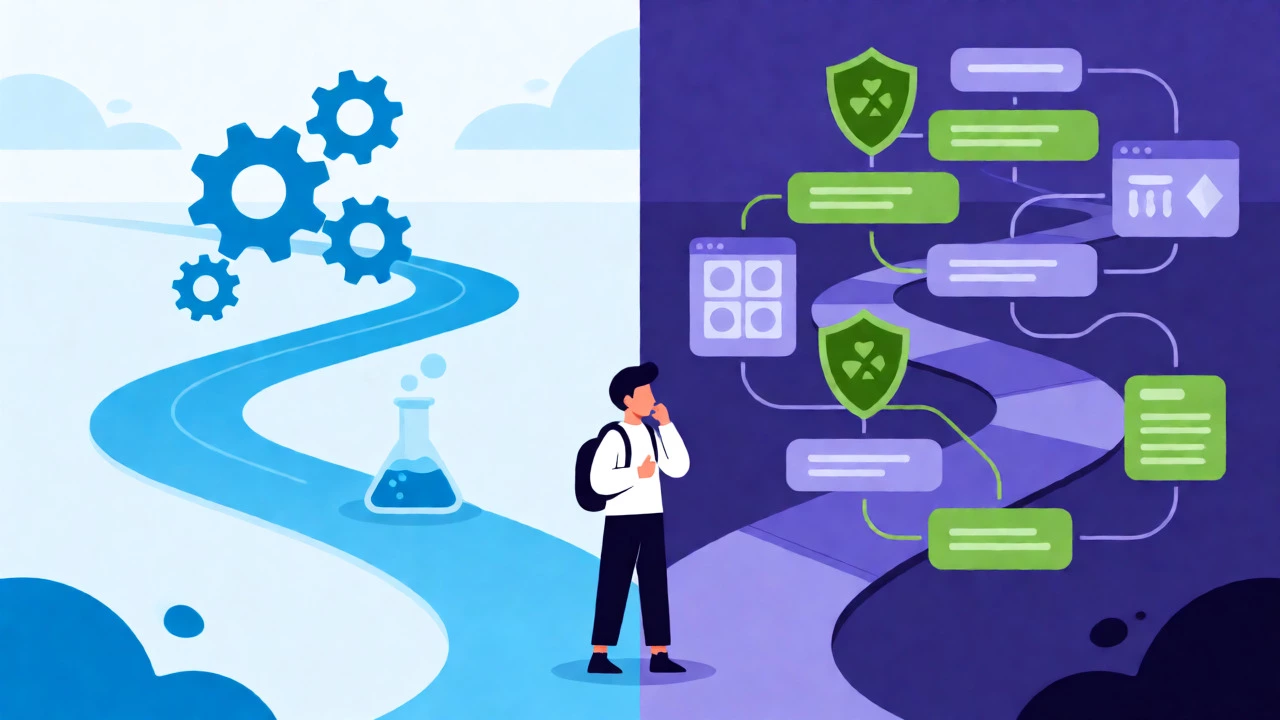
Here is the hard truth: there is no single "easiest" framework for everyone. The easiest framework depends entirely on what you already know and what you want to build. But we can narrow it down. For most beginners in 2026, the path of least resistance usually leads to Flask or Express.js. These tools strip away the magic, letting you see exactly how your code works. Once you understand them, moving to heavier hitters like Django or Laravel becomes manageable rather than terrifying.
Defining "Easy" in Modern Development
Before we rank anything, we need to define what makes a framework easy. It isn't just about writing fewer lines of code. True ease comes from low cognitive load. Can you get a "Hello World" page running in under five minutes? When something breaks, does the error message tell you what went wrong, or does it throw a stack trace that looks like alien hieroglyphics?
In 2026, the landscape has shifted slightly. AI coding assistants handle boilerplate well, but they struggle with complex architectural decisions. This makes simple, explicit frameworks more valuable than ever. You need to understand the structure so you can guide the AI, not just copy-paste its output blindly. An easy framework teaches you concepts; a hard one hides them behind abstraction layers.
The Minimalist Contenders: Flask and Express.js
If you want to learn by doing, start small. Two names dominate this space: Python’s Flask and JavaScript’s Express.js.
Flask is a micro-framework written in Python. It doesn’t force you to use a specific database or template engine. You install it, import it, and write two lines of code to serve a webpage. Because Python reads like English, the barrier to entry is incredibly low. You aren’t wrestling with curly braces or semicolons. You are focusing on logic. However, because it is minimal, you must manually add extensions for things like user authentication or form validation. This extra step forces you to understand what those components actually do.
On the JavaScript side, Express.js remains the standard for Node.js applications. If you already know some JavaScript, this is your fastest route to a backend. It uses middleware functions to handle requests. The concept of "middleware"-functions that run in sequence before sending a response-is crucial for modern web development. Learning Express teaches you how HTTP requests flow through a server. Unlike full-stack frameworks, Express doesn’t hide the request-response cycle. You see it. You control it. This transparency builds confidence quickly.
The Full-Stack Powerhouses: Django and Laravel
Sometimes, minimalism becomes tedious. You find yourself installing ten different packages just to manage a database connection. That’s where "batteries-included" frameworks shine. They come pre-packed with everything you need. The trade-off? A steeper learning curve upfront.
Django is often cited as the easiest full-stack framework for beginners who prefer structure over freedom. Built on Python, it follows the Model-View-Template (MVT) architecture. Its killer feature is the Admin Panel. Within minutes of setting up a model, you get a fully functional interface to manage your data. No HTML required. For students building portfolio projects, this saves hours. Django also handles security vulnerabilities like SQL injection automatically. You don’t have to remember to sanitize inputs; the framework does it for you. The downside is rigidity. Django wants you to do things its way. If you try to fight the convention, you will suffer.
For PHP developers, Laravel offers a similar experience. It is arguably the most developer-friendly framework in existence right now. The syntax is elegant, almost poetic. Laravel provides tools like Eloquent ORM, which lets you interact with your database using simple object-oriented commands instead of raw SQL queries. It also includes a robust ecosystem for queues, caching, and task scheduling. If you want to build a social network or an e-commerce site quickly, Laravel removes the friction. But if you’ve never touched PHP, the language itself might be the hurdle, not the framework.
Comparing the Heavyweights
To help you decide, let’s look at these four contenders side-by-side. We evaluated them based on setup time, documentation quality, and community support.
| Framework | Language | Setup Time | Learning Curve | Best For |
|---|---|---|---|---|
| Flask | Python | < 5 mins | Low | Microservices, Prototypes, Learning Basics |
| Express.js | JavaScript | < 10 mins | Low-Medium | APIs, Real-time Apps, JS Developers |
| Django | Python | ~30 mins | Medium-High | Complex Data Models, Admin-heavy Apps |
| Laravel | PHP | ~20 mins | Medium | Rapid Application Development, Startups |
Notice the pattern? The lighter frameworks take less time to set up but require more manual work later. The heavier ones take longer to configure but save you time during development. Your choice depends on whether you value immediate feedback or long-term speed.
How to Choose Based on Your Background
Stop looking for the objectively best framework. Look for the best fit for your current skill set.
- If you know zero coding: Start with Flask. Python is forgiving. Errors are readable. You won’t feel stupid trying to debug a missing colon.
- If you know HTML/CSS and basic JavaScript: Go with Express.js. You stay in one language ecosystem. Switching between frontend JS and backend JS reduces context switching fatigue.
- If you are a university student studying CS: Pick Django. Professors love Django because it enforces good practices. Plus, the admin panel impresses non-technical stakeholders instantly.
- If you want to freelance immediately: Learn Laravel. There is a massive market for PHP/Laravel jobs. Clients pay for results, not purity. Laravel delivers results fast.

Pitfalls That Make Frameworks Feel Hard
Many beginners quit not because the framework is hard, but because they misunderstand the role of the framework. Here are common traps.
First, premature optimization. Don’t worry about scaling to millions of users while you’re still figuring out how to display a list of items. Use the simplest tool that works. Second, tutorial hell. Watching someone else code is passive. You must type the code yourself. Break things. Delete a line and see what happens. Third, ignoring documentation. Tutorials age poorly. Documentation is the source of truth. Learn to read docs early. It feels slow now, but it pays dividends later.
Another trap is mixing too many technologies. If you choose React for the frontend, don’t try to learn GraphQL, TypeScript, Docker, and Kubernetes all at once. Stick to the basics. Build a monolith first. Splitting services is an advanced topic, not a beginner requirement.
The Verdict for 2026
So, what is the easiest web framework? If you want the absolute lowest barrier to entry, Flask wins. It is small, understandable, and leverages Python’s simplicity. If you are committed to JavaScript, Express.js is the clear winner.
But here is a secret: the framework matters less than your ability to solve problems. A skilled developer can build anything with any tool. An unskilled developer will struggle even with the easiest tool. Focus on understanding HTTP, databases, and routing. These concepts transfer across every framework. Once you grasp them, switching from Flask to Django takes a weekend, not a month.
Is Flask really easier than Django for beginners?
Yes, initially. Flask requires less configuration and allows you to see the entire application structure in a few files. Django has more "magic" happening behind the scenes, which can confuse beginners until they understand its conventions. However, Django becomes easier to maintain as the project grows larger due to its structured approach.
Should I learn Express.js or Next.js first?
Learn Express.js first if you want to understand backend fundamentals. Express is a pure backend framework. Next.js is a full-stack React framework that abstracts much of the backend complexity. Understanding Express helps you appreciate what Next.js is doing for you, making you a better full-stack developer.
Which framework has the best job market in India?
As of 2026, JavaScript frameworks like React and Node.js (Express) have the highest volume of job postings globally and in major Indian tech hubs like Bangalore and Hyderabad. However, Python-based roles involving Django are growing rapidly in data-driven companies and startups. Laravel remains strong in the freelance and SME sector.
Do I need to know databases before choosing a framework?
Basic knowledge helps, but isn't mandatory. Most beginner tutorials include database setup. Frameworks like Django and Laravel provide Object-Relational Mappers (ORMs) that let you interact with databases using code instead of SQL. This lowers the barrier significantly, allowing you to learn SQL concepts gradually alongside your framework skills.
Can I switch frameworks after learning one?
Absolutely. In fact, it is recommended. The core concepts of routing, middleware, and MVC/MVT architecture are universal. Moving from Flask to Django or Express to Laravel is primarily about learning new syntax and libraries, not relearning computer science fundamentals. Employers value versatility.